Fountain pen ink guide: types, properties, and how to choose without overwhelm
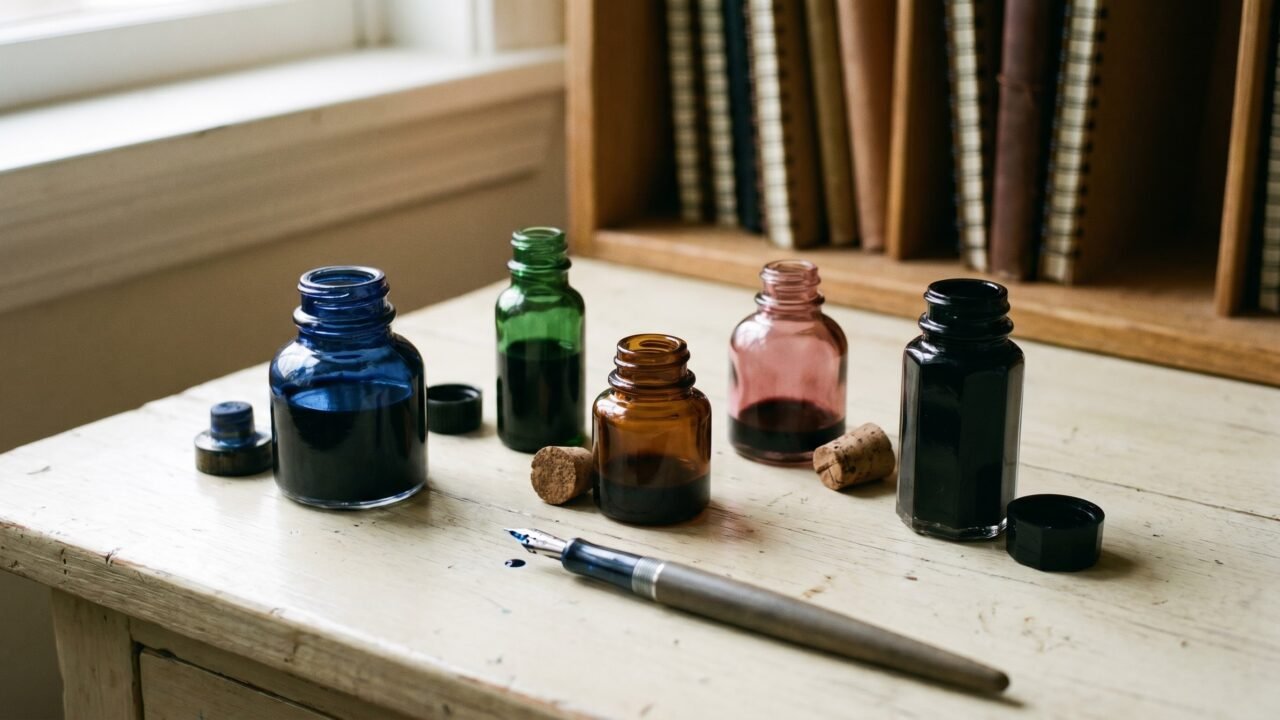
Fountain pen ink is a water-based liquid engineered to flow through narrow metal passages by capillary action alone. That single fact explains almost every rule that follows: the ink must stay fluid, must not dry into a hard residue inside the feed, and must carry enough dye or pigment to leave a legible, lasting mark. Understanding those basics makes every ink decision easier, whether you are picking your first bottle or managing a collection of 40.
Most standard fountain pen inks are dye-based. A smaller category uses pigment particles. And a third type, iron gall, is something older and more chemically interesting than either. Knowing the difference tells you which inks are forgiving, which demand attention, and which you should leave on the shelf until you are ready for them.
The three chemistry families at a glance
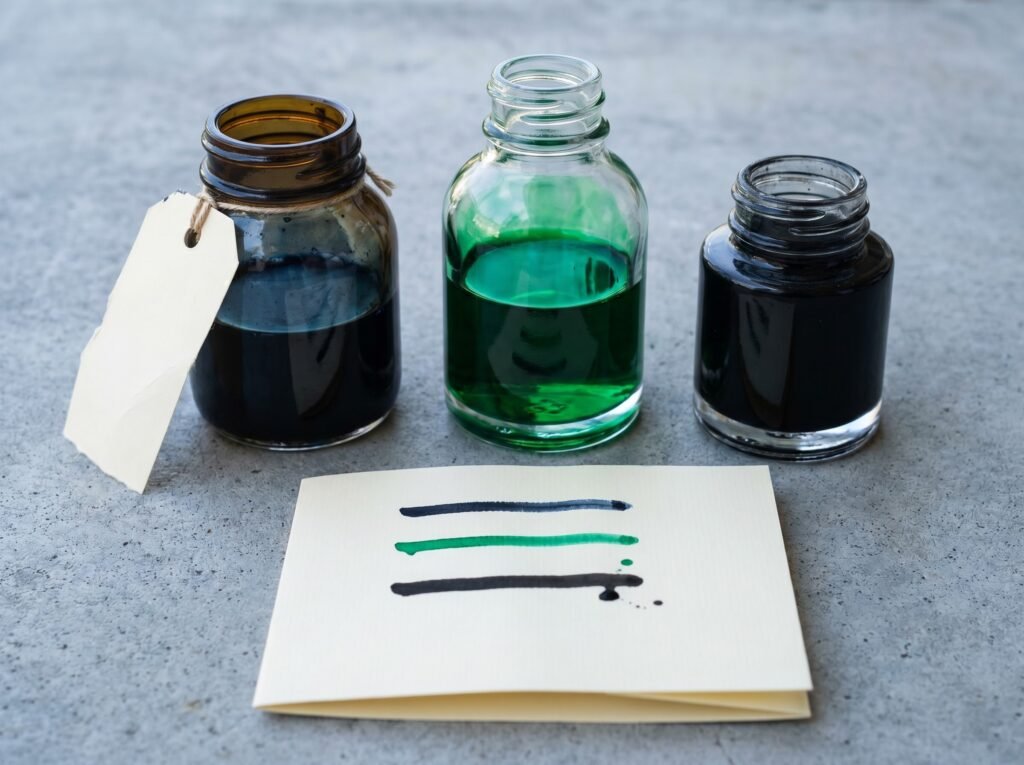
Before anything else, here is the ink-type-at-a-glance table. It summarizes the most important trade-offs across all three families so you can use it as a quick reference any time you are evaluating a new bottle.
| Type | How color is carried | Water resistance | Pen safety | Main risk | Best for |
|---|---|---|---|---|---|
| Dye-based | Dye molecules dissolved in water | Low to none (most formulas) | Very high – gentle on feeds and materials | Fades in direct sunlight over years | Daily writing, beginners, color variety |
| Pigment-based | Nanoparticle solids suspended in water | High – waterproof when dry | Good with daily use; clogs if pen sits idle | Dries and blocks feed within days of non-use | Archival documents, artwork, journaling |
| Iron gall | Ferrous tannate (reacts with paper and air) | High once oxidized | Moderate – acidic; needs regular flushing | Corrodes metal parts and clogs feed if neglected | Permanent records, vintage pen collectors who flush regularly |
Dye-based inks
Dye-based inks are the default choice for good reason. The color molecules dissolve completely in water, so there are no particles to settle or clog narrow passages. They clean out of pens easily and come in the widest range of colors. Pilot’s Iroshizuku line, LAMY bottled inks, Diamine, Sailor Jentle, and Pelikan 4001 are all dye-based. These are the inks to start with, and for most writers they will always be the largest part of a collection.
The limitation is permanence. Most dye-based inks are water-soluble after they dry, meaning a splash of rain can smear a line written an hour ago. They also fade in direct, prolonged sunlight over several years. For daily journaling or letter writing that will live in a drawer, neither issue matters at all.
Pigment-based inks
Pigment inks carry their color as extremely fine solid particles suspended in water rather than dissolved in it. When the ink dries, those particles lodge between the paper fibers and stay put, resisting water, light, and even mild solvents. Platinum’s Carbon Black, introduced in May 2001, is the most widely referenced example. Platinum describes it as “very suitable for writing on public documents, contracts etc.” because of that permanence.
The trade-off is maintenance. If a pigment-loaded pen sits unused for more than a few days, the particles can settle and dry into a blockage in the feed. Platinum recommends cleaning Carbon Black from the pen at least once a week. Use a pigment ink only in a pen you write with every day, and flush it completely before any planned break.
Iron gall inks
Iron gall is the oldest of the three. The chemistry starts with mixing tannin (traditionally extracted from oak galls) with iron sulfate. This creates a water-soluble ferrous tannate complex that flows through a pen normally. Once on paper and exposed to oxygen, it oxidizes into ferric tannate, an insoluble compound that is effectively impossible to wash off. That oxidation reaction is why iron gall documents from centuries ago still survive in archives.
The acidity is what demands respect. The Wikipedia article on iron gall ink documents that ferro-gallic deposits can accumulate in narrow pen passages, and that very acidic traditional formulas can corrode metal components. Modern iron gall inks from brands like Rohrer and Klingner, KWZ, or Platinum’s own blue-black are formulated with lower acid concentrations than historical recipes, but they still require more frequent flushing than dye-based inks. Once a week is a reasonable minimum. Never let iron gall ink sit in a pen for weeks at a time.
The property vocabulary you actually need
Ink descriptions use a set of terms that sound technical but each refers to something observable. Once you know them, reading any ink review or bottle description becomes straightforward.
Saturation is how deeply colored the ink looks on paper. A highly saturated ink lays down an intense, rich line. A low-saturation ink appears lighter or more washed-out. Neither is better; they serve different purposes.
Shading happens when a stroke shows visible variation from light to dark along its length, tracking where the nib deposited more or less ink. High-shading inks can make everyday writing look almost painted. It shows best on smooth paper with a nib that flows generously.
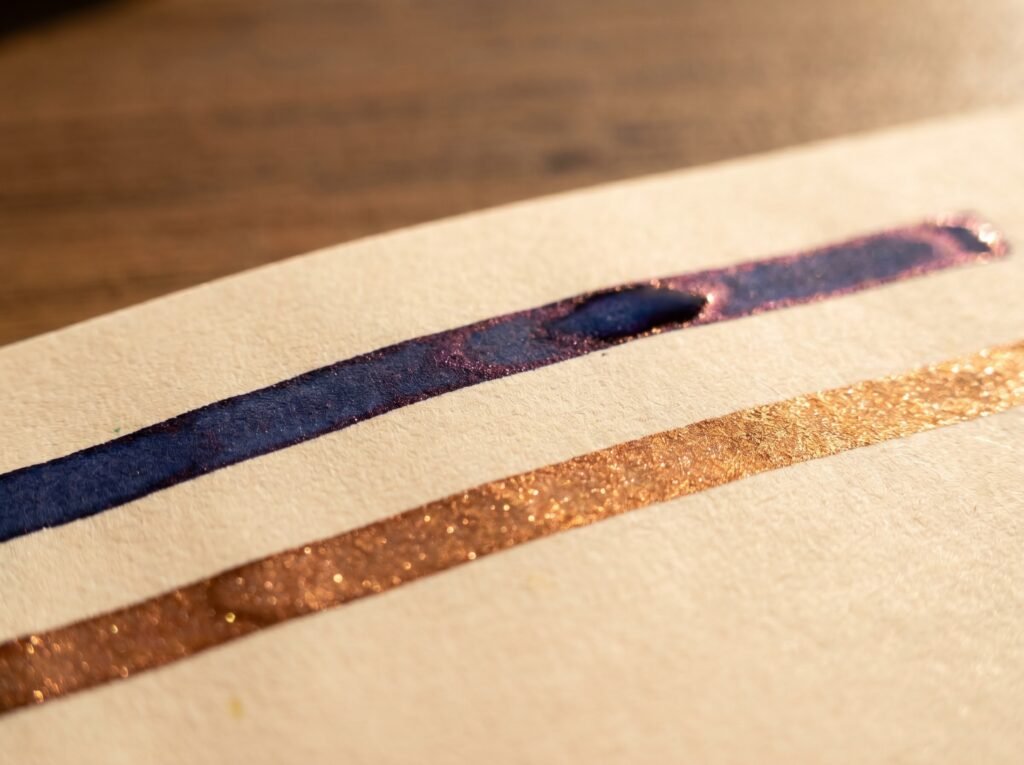
Sheen is an optical effect caused by a very high concentration of dissolved dye molecules collecting at the surface of the paper after the water evaporates. The result is an iridescent metallic flash in a contrasting color: blue ink that gleams purple at certain angles, or red ink with a gold sheen. Sheen requires fountain-pen-friendly paper and a fairly wet nib to appear. On absorbent paper, it disappears entirely.
Shimmer is different from sheen. Shimmer inks contain actual suspended mica or metallic powder particles that create a sparkly, glitter-like appearance in the line. Because those particles are physical rather than dissolved, they can clog a nib. The enthusiast community widely reports that shimmer inks should be reserved for medium or broader nibs, and that fine and extra-fine nibs are particularly prone to blockage from the particles. The shimmer particles do not dissolve but can be flushed out with thorough rinsing, which makes cleaning a more involved process than a standard flush. For more on shimmer ink safety, see Shimmer ink safety: what you need to know before you fill up.
Flow describes how wet or dry a particular ink runs through a pen. A wet-flowing ink lays down a thick, saturated line; a dry ink lays down less. Flow is partly an ink property and partly a nib property, and the two interact. The pairing rule that experienced writers follow: pair a wet-flowing nib with a dry ink, or a dry-running nib with a wet ink. Japanese nibs (Pilot, Sailor, Platinum) tend to run on the drier side. German nibs (LAMY, Pelikan) tend to run wetter. Matching the two avoids either a scratchy, starved line or bleed-through from oversaturation. There is a full breakdown of how to match the two in Wet nib, dry ink: the pairing rule explained.
Water resistance ranges from zero (most standard dyes wash away completely when wet) to high (pigment and iron gall inks resist washing once dry). Manufacturers sometimes use terms like “document ink,” “bulletproof,” or “registrar’s ink” to signal water resistance or permanence. These mean the same thing in different brand vocabularies.
pH matters more than most beginners realize. Strongly alkaline inks can degrade latex rubber sacs and celluloid in vintage pens. Strongly acidic inks, including some iron gall formulas, can corrode early steel components. For a modern pen made of stainless steel or aluminum, pH rarely causes visible damage within normal use periods. For a vintage pen with a rubber sac or celluloid barrel, choosing a neutral-pH ink like Waterman, Pelikan 4001, or standard Diamine is genuinely important.
Safe inks versus inks that will damage your pen
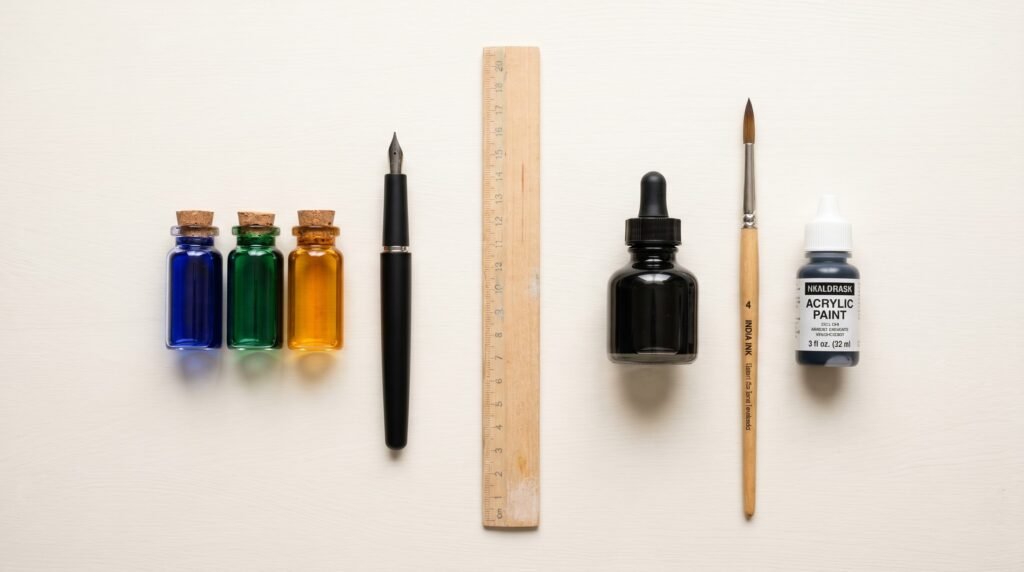
This is where beginners sometimes learn expensive lessons, so the rules here are firm.
The short version: use only inks specifically labeled and sold for fountain pens. Every major ink manufacturer produces fountain pen ink that is water-based, free of resins, shellac, or heavy pigment binders, and formulated to stay fluid in a narrow-channel feed.
Three categories of non-fountain-pen ink cause serious damage and must be kept out of any standard fountain pen entirely:
- India ink: contains shellac (a resin) that hardens inside the feed. Shellac dissolves only in denatured alcohol or ammonia, both of which damage pen materials. If India ink dries in a pen, the damage is often irreversible.
- Calligraphy and dip-pen inks: formulated for broad metal nibs dipped in an open reservoir, not for the micro-channels of a fountain pen feed. They typically contain heavy pigment binders or shellac that will clog a fountain pen permanently.
- Acrylic inks: dry into a hard plastic film. Once set inside a feed, they cannot be dissolved safely.
The article What happens when you put the wrong ink in a fountain pen covers the specific damage mechanisms and what to try if it has already happened.
Within the world of legitimate fountain pen inks, there are still a few caution cases:
- Noodler’s Baystate inks: these inks run at a pH between 8 and 9, more alkaline than nearly all other fountain pen inks. The maker has stated that Baystate inks must not be mixed with any non-Baystate ink, even in trace amounts left in the feed from a previous fill. The alkaline chemistry reacts with standard dye-based inks to form a clog. Mix only Baystate with Baystate. More detail on ink mixing safety is in Can you mix fountain pen inks?
- Shimmer inks in fine nibs: reserve shimmer for medium or broader nibs. The mica particles block EF and fine nibs reliably.
- Iron gall in vintage pens: vintage pens with latex rubber sacs or early steel snorkel tubes should not use iron gall regularly. Acid attacks both. Safe vintage-pen inks include Waterman, Pelikan 4001, Parker Quink, and standard Diamine shades.
- Pigment ink in pens you do not use daily: flush any pigment ink out of a pen before a break of more than a few days.
One more rule worth knowing before you buy your first pen: flush a brand-new pen with water before the first fill. Factory assembly leaves trace oils in the feed and nib slit that can cause hard starts or inconsistent flow. A rinse or two with plain water removes them. The paper guide for preparing a new pen walks through the full process: How to prepare a new fountain pen before first use.
Starting an ink collection without feeling overwhelmed
The ink market is enormous. Hundreds of brands, thousands of colors, a vocabulary of shading and sheen and shimmer. It is easy to freeze up.
A practical starting point: pick one well-reviewed dye-based ink in a neutral color and use it until you understand how it behaves in your pen, on your paper, in your handwriting. Then add a second color. Ink is one of the cheapest parts of fountain pen ownership – even a small bottle lasts most writers many months of daily writing. Experimenting is low-risk, and mistakes with dye-based ink rarely damage a pen.
A few things worth knowing before that first purchase:
- Ink behavior depends heavily on the paper you use. The same ink can feather badly on copy paper and look flawless on fountain-pen-friendly paper. Before blaming an ink for ugly results, try a different paper. The guide on fountain pen paper: which surfaces work and which ones waste your ink lays out the differences clearly.
- Japanese nibs run approximately one size finer than Western nibs. A Japanese medium writes like a Western fine. This changes how wet an ink appears, how much shading shows, and whether shimmer particles pass through the feed. It is covered in depth in Japanese vs. Western nib sizes explained.
- Color behavior can surprise you. Some inks look entirely different on coated paper versus absorbent paper. Sheen vanishes on absorbent surfaces. Shimmer also disappears. Shading is most visible on smooth, slow-absorbing paper.
The ink spoke articles below go deep on specific categories. Each one is a standalone guide to its topic, so read the ones that match where you are now and return to others as your collection grows.
The ink spoke articles on Nibhaven
This guide is the hub. Each article below covers one aspect of ink in more depth than a hub article can:
- Best fountain pen inks for beginners: the starting bottles
- Fountain pen ink brands compared: who makes what and why it matters
- Pilot Iroshizuku guide: all 24 colors rated for shading, sheen, and behavior
- Shimmer ink safety: what you need to know before you fill up
- Can you mix fountain pen inks? The rules and the exceptions
- What happens when you put the wrong ink in a fountain pen
- How long does fountain pen ink last in a bottle and in a pen?
- How to remove fountain pen ink stains from skin, fabric, and paper
Cleaning your pen when you change inks is also part of building a healthy ink habit. The guide on how to clean a fountain pen covers the full process.
Frequently asked questions
Can I use any fountain pen ink in any fountain pen?
Any ink labeled specifically for fountain pens can go in any fountain pen. The restriction is on inks made for dip pens, calligraphy, drawing, or India ink use: those contain shellac, resins, or heavy pigment binders that block the narrow passages inside a fountain pen feed. Stick to fountain-pen-labeled inks and you are safe.
How often should I clean my pen when switching inks?
Every time you switch inks, flush the pen thoroughly with plain water until the water runs clear. This removes residue from the previous ink that might react with the new one. For pigment inks or iron gall inks, use more flushes than you think you need. Baystate inks require thorough cleaning before introducing any other ink.
Do expensive inks write better than cheap ones?
Price reflects color variety, bottle design, and brand positioning more than raw writing performance. Many affordable inks from Diamine, LAMY, and Waterman write as smoothly as inks costing three times as much. Expensive specialty inks often offer more dramatic shading, sheen, or shimmer effects, which is a matter of personal preference, not functional superiority.
Why does my ink look different on different paper?
Paper absorbency determines how ink spreads and dries. Highly absorbent paper drinks ink fast, widening lines, muting shading, and eliminating sheen entirely. Smooth, coated paper lets ink sit longer at the surface, producing finer lines, richer shading, and visible sheen. The paper guide on Nibhaven covers which surfaces to seek and which to avoid.
The Nibhaven team
We write plain-English fountain pen guides. Every claim is checked against the manufacturer documentation and primary sources listed above before publishing.