How to write with a fountain pen: technique that actually works for beginners
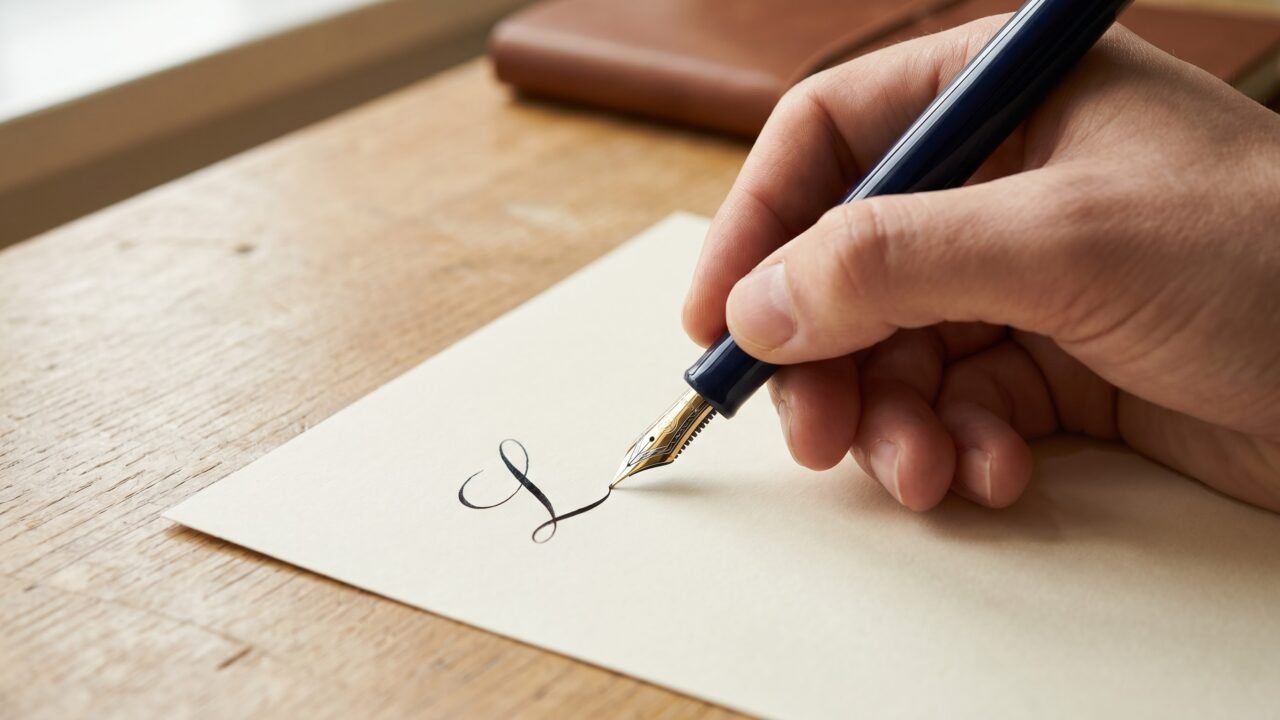
Writing with a fountain pen feels completely different from writing with a ballpoint, and not because the pen is harder to use. The physics are different. A ballpoint needs pressure to push thick oil-based ink past a rotating ball. A fountain pen delivers water-based liquid ink through capillary action: narrow channels in the feed draw ink forward the moment the nib touches paper, and air flows back into the reservoir to keep the supply steady. Gravity and capillary action do the work. Your hand supplies almost none of the force.
That one mechanical fact explains why every scratchy, skipping, or uncooperative experience a beginner has almost always traces back to three things: wrong angle, too much pressure, or the nib rotating off its sweet spot. Fix those three, and most pens write beautifully.
The angle that makes ink flow
Hold your fountain pen so the barrel makes roughly a 40 to 55 degree angle with the paper. For most people, 45 to 50 degrees is the range where the nib’s tines sit flat against the writing surface and ink transfers evenly. At a steeper angle (more upright, closer to 90 degrees), only the tip’s edge contacts the paper and flow becomes unreliable. Flatter than about 40 degrees, the back of the nib can drag on the page.
Grip the pen at the section – the narrow tapered part directly above the nib, not the barrel farther back. Your thumb and index finger rest lightly on the section, with the middle finger supporting from underneath. Holding too far back shifts the balance and makes it harder to keep a steady 45-degree angle.
This is a gentler angle than most people instinctively use. Ballpoint users tend to hold their pens quite upright, sometimes near 60 to 70 degrees, because that stance transfers downward force efficiently onto the rotating ball. On a fountain pen that same posture fights the ink delivery system. A.T. Cross’s writing guide specifies the 40-55 degree range as the zone where the nib maintains full contact with the page, supporting consistent ink delivery.
If you are learning how to hold a fountain pen, set your paper at a slight angle on the desk rather than straight in front of you. Many writers find this makes the 40-50 degree pen angle feel more natural and helps the arm move in a consistent arc.
The no-pressure rule (and why it is the whole game)
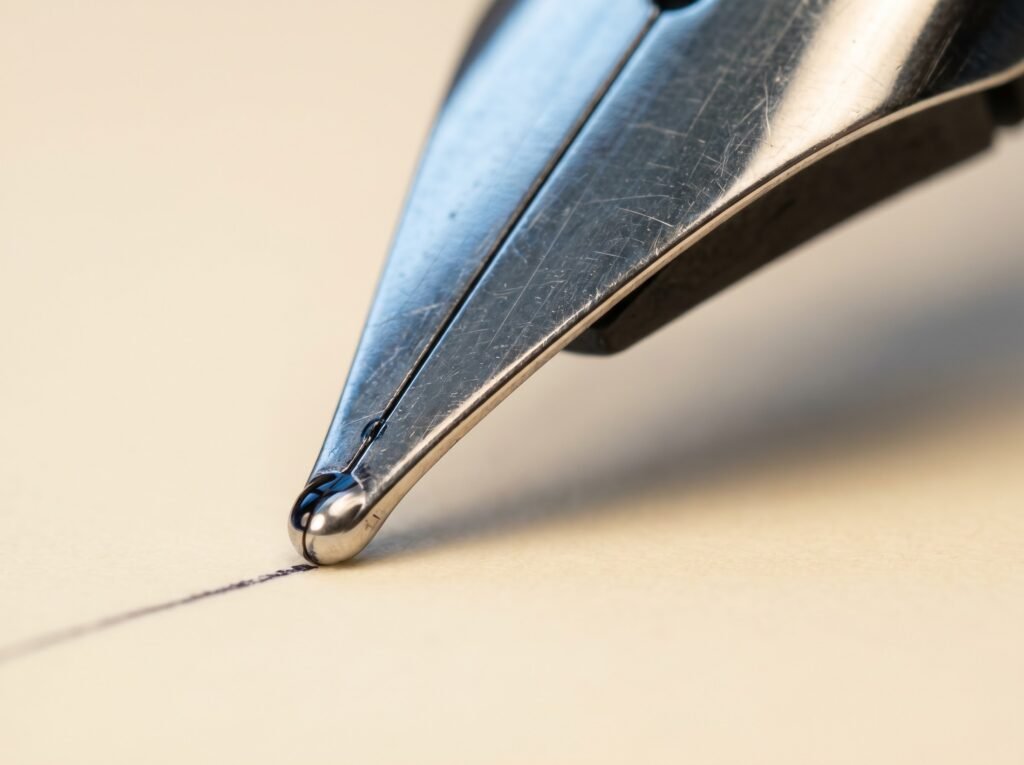
A properly functioning fountain pen writes under almost no downward force. The pen’s own weight, resting lightly against the paper, is enough. Scriveiner’s pen guides describe the principle simply: “use minimal downward force, just enough to maintain nib-to-paper contact.”
Here is the mechanics of why this matters. The nib has a central slit that splits into two tines near the tip. Those tines are shaped with a slight inward bend, which holds the slit slightly open even at rest, letting capillary action draw ink forward. When you press down, the tines splay apart under load. Moderate pressure widens the slit and produces a wetter, broader line. Heavy pressure, though, collapses the flow geometry entirely: the tines splay so far that capillary action breaks and the ink stops. The Dayspring Pens guide on fountain pen mechanics puts it plainly: “too much will bend your nib.”
The writer coming from ballpoints has a muscle memory problem. Years of pressing into the page to move thick oil-based ink leaves an ingrained habit that fights the fountain pen on every stroke. The fix is not complicated. Rest your writing hand on the paper rather than bracing against it. Let the pen’s weight be the only force going down. After a short practice session, most writers report that the light touch becomes natural quickly.
If your current pen is skipping or stopping mid-word, technique is the first place to check before assuming the pen is defective.
Finding the sweet spot by rotating the pen
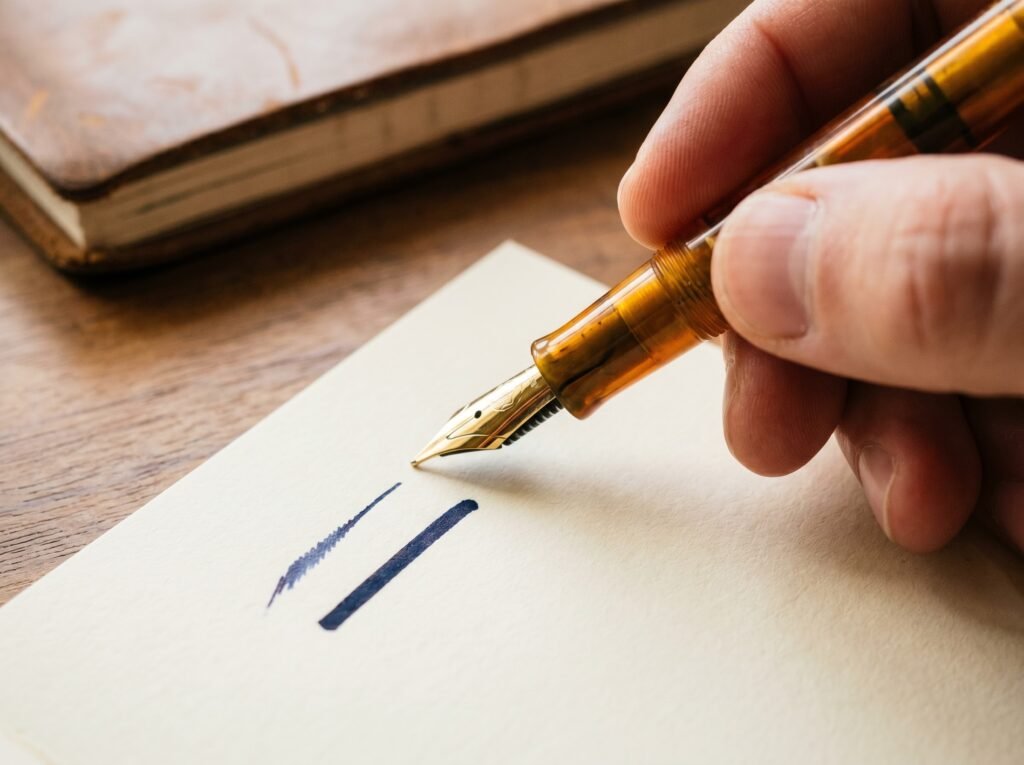
Every nib has a sweet spot: the small polished zone on the writing tip where the tipping material curves just right to glide across paper on a thin layer of ink. Richard Binder’s reference work on fountain pen nibs explains it well: nibs are manufactured and calibrated to sit at an elevation of 40-55 degrees above the paper, held straight, not rotated. When the nib sits exactly at that position, the sweet spot faces the paper squarely and ink flows cleanly.
The problem is that small variations exist between individual pens, even within the same model. One pen may flow best at 43 degrees; another at 50. Small manufacturing tolerances in the tipping shape and tine geometry shift the sweet spot slightly.
The practical fix is simple: before committing to a writing session, test the pen on scrap paper. Hold it at your natural 45-degree angle and write a few letters. If the pen feels rough or skips, rotate the barrel very slightly toward you (rolling it between fingers by perhaps five degrees) and try again. Then rotate slightly away and compare. One position will feel noticeably smoother. That is your pen’s sweet spot, and once you have found it, you aim to keep the pen in that rotation throughout your writing. This is why the arm-movement technique matters: when you move the arm and shoulder as a unit rather than repositioning fingers, the barrel rotation stays consistent, keeping you on the sweet spot.
Italic and stub nibs have smaller sweet spots than round nibs and are much less forgiving of rotation. If you are writing with a specialty nib and experiencing scratchy feedback, the first fix is always to get back to a consistent barrel angle.
Why ballpoint habits fight you
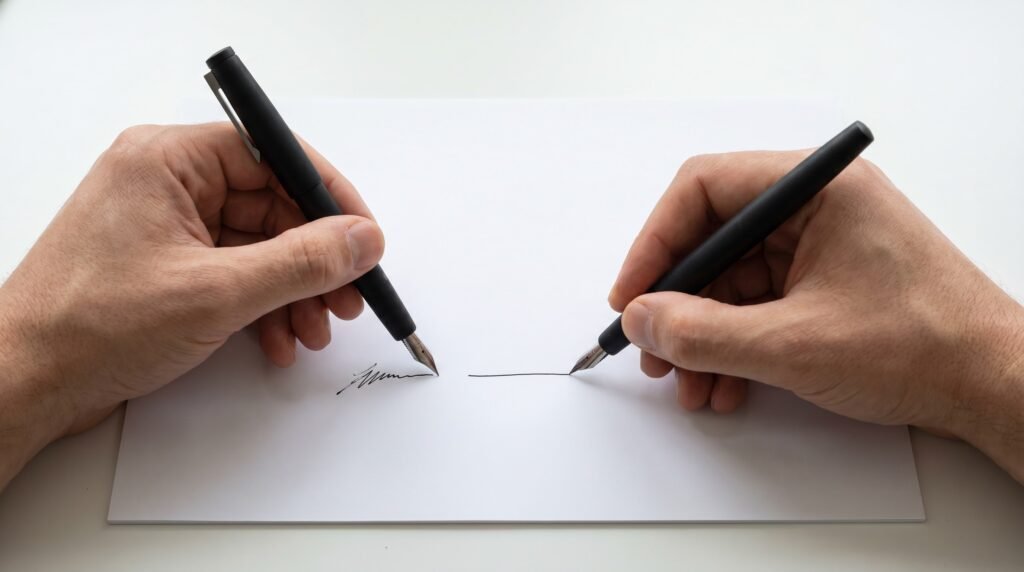
Three specific ballpoint habits cause trouble on a fountain pen.
- Pressing hard. Ballpoint ink is thick and viscous; it needs pressure to be forced past the rotating ball and onto the paper. Water-based fountain pen ink flows by capillary action with no mechanical force. Pressing hard on a fountain pen does not help, it disrupts the flow geometry described above.
- Writing at a steep upright angle. Ballpoints work fine near 70 degrees. Fountain pens need 40-55 degrees for the nib’s tines to sit flat and deliver ink evenly.
- Rotating the pen in the fingers. Ballpoints write equally well at almost any rotation because the ball bearing rolls in every direction. A fountain pen nib has an asymmetric sweet spot, and unconscious finger-rotation mid-word knocks you off it, producing a sudden scratchy patch that feels like a nib defect.
None of these habits are hard to break, but awareness is the first step. The moment a fountain pen starts skipping or scratching, run through those three items before doing anything else.
Quick fixes for skipping caused by technique
When a pen skips and no mechanical fault is obvious, work through this order of checks before concluding the pen needs service.
| Symptom | Likely technique cause | Fix |
|---|---|---|
| Skips every few strokes | Pen angle too steep or too flat | Adjust toward 45-50 degrees; test on scrap paper |
| Skips in the middle of a letter | Finger-rotation off sweet spot | Rotate barrel slightly, test both directions, lock in smoother position |
| Starts fine then goes dry | Pressure building up from unconscious grip tightening | Consciously relax grip; rest hand on paper surface instead of bracing |
| Hard start on the first stroke | Often a new pen with residual factory oil in the feed | Flush the pen with room-temperature water before the first fill; enthusiasts widely report this resolves factory hard starts |
| Scratchy but ink flows fine | Nib rotation off sweet spot, or paper is too rough | Rotate barrel to find smoother position; try smoother paper; if still scratchy, see how to smooth a scratchy nib |
One clarification on that last row: there is a difference between a pen that feels scratchy because of technique and one that feels scratchy because a tine tip is rough or misaligned. Technique is always the first hypothesis. If rotating the barrel and adjusting the angle produces no improvement on any paper type, the problem is likely in the nib itself. Gentle micro-smoothing with a very fine substrate (enthusiasts use mylar sheets or the rough striker strip on a matchbook) can sometimes help, but repairs beyond that belong to a nibmeister. Do not attempt to reshape tines with household tools.
Letting the ink do the work: putting it together
Good fountain pen technique comes down to four things working in combination: angle around 45-50 degrees, pressure near zero, barrel rotation locked on the sweet spot, and arm movement rather than finger movement driving the strokes. Get those right and the ink flows continuously, the nib glides, and writing feels effortless in a way that no ballpoint can match.
A word on arm movement: this means moving the whole forearm as a unit from the elbow, keeping the fingers still rather than flexing them to push individual strokes. When the fingers do the work, the pen rotates slightly on every letter, knocking the nib off its sweet spot. When the arm moves as a unit, the pen stays at the same angle and rotation throughout a word. Many beginners find this feels awkward at first because it differs from how they learned to write with ballpoints. A short practice session on scrap paper usually makes it click.
A useful practice drill: write a few lines of loose cursive on smooth scrap paper with your eyes closed, deliberately using only the weight of the pen as downward force. Most writers are surprised how little pressure is needed. After two or three lines, open your eyes and check the writing. Consistent line width and smooth flow mean your pressure calibration is correct. Thickening lines or dried patches mean pressure crept up mid-word.
One more thing worth knowing: if you are holding your first fountain pen and the results are inconsistent, the pen may genuinely need attention before technique adjustments can help. Pens shipped with factory oil in the feed, or pens that have dried ink in the feed from sitting unused, will give unpredictable flow even with perfect technique. A thorough flush with room-temperature water, followed by refilling with fresh ink, fixes most cases. See the full guide on troubleshooting a fountain pen that skips for a complete flow-problem checklist.
The bigger picture: the fountain pen’s whole design assumes you will be gentle with it. The same capillary system that delivers effortless ink flow also means the pen rewards a light, consistent hand. Ballpoints are built to take pressure; fountain pens are built so you never need to apply it.
Frequently asked questions
How hard should I press when writing with a fountain pen?
Barely at all. The pen’s own weight resting on the paper is sufficient. Fountain pens deliver ink through capillary action and gravity, not pressure. If you find yourself pressing to get ink out, first check your writing angle (should be 40-55 degrees) and look for the pen’s sweet spot by rotating the barrel slightly.
Why does my fountain pen skip even though it has ink?
The most common causes are technique-related: too steep an angle, too much pressure (which can collapse tine geometry and stop flow), or the nib rotating off its sweet spot. Work through those three checks before assuming a mechanical fault. A clogged feed from dried ink is the next most common cause and a thorough water flush usually resolves it.
Which way should the nib face when I write?
The flat (engraved) face of the nib should face up, toward the ceiling. The smooth curved underside contacts the paper. Writing with the nib face down is called reverse-nib writing and produces a very different (usually finer and scratchier) line; most pens are not designed for it.
Can I use my fountain pen on any paper?
Not ideally. Very rough, absorbent paper (like cheap copy paper) will make even a well-tuned pen feel scratchy and cause ink to feather or bleed through. Smooth papers rated for fountain pens (Rhodia, Clairefontaine, Tomoe River, and similar) give the nib a proper surface to glide on. If a pen feels rough only on certain paper and smooth on others, the paper is the variable.
Is fountain pen technique different for left-handed writers?
Yes, slightly. Left-handed writers often push the nib across the page rather than pulling it, which can cause skipping on standard nibs. An overwriter (hand below the line) has less trouble than an underwriter (hand above the line curling around). Fine and medium nibs with fast-drying inks work better for lefties; broad wet nibs smear easily. The core angle and pressure principles are the same regardless of hand.
The Nibhaven team
We write plain-English fountain pen guides. Every claim is checked against the manufacturer documentation and primary sources listed above before publishing.