Fountain pen reviews: how Nibhaven evaluates every model, with an index by budget and use case
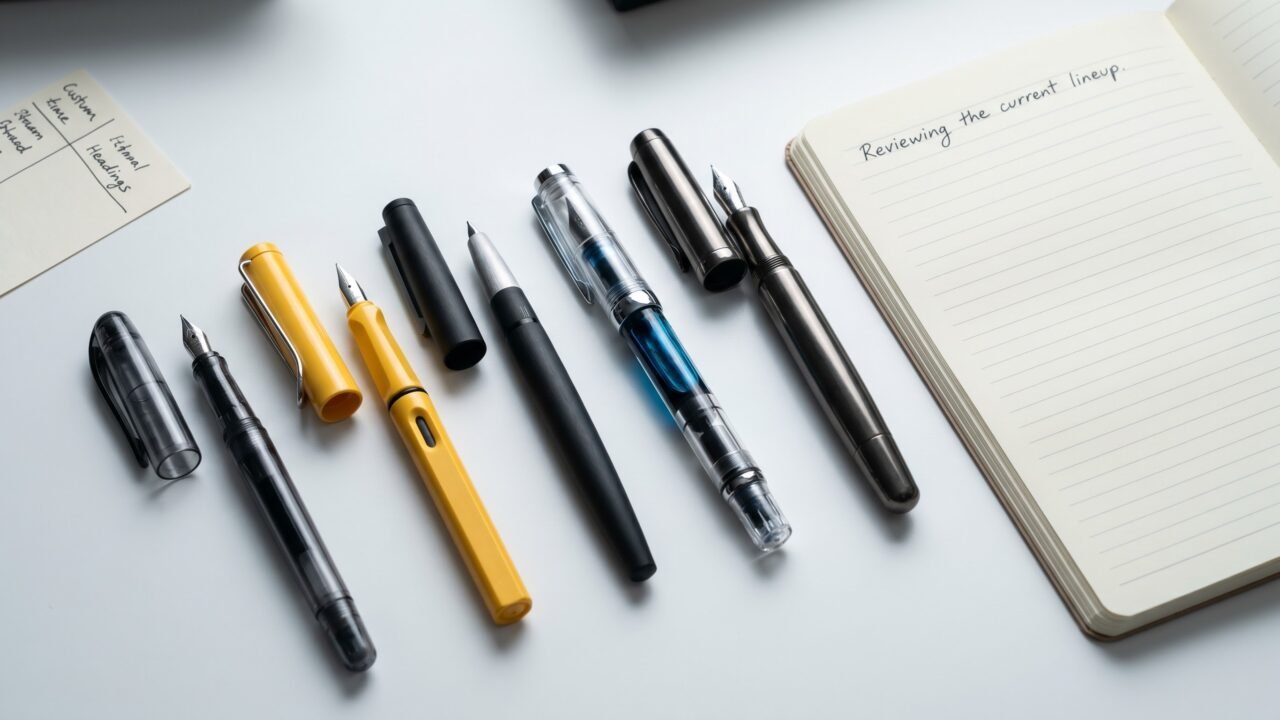
Fountain pen reviews can mean very different things: a quick first impression, a year of daily use, or a dry spec comparison. At Nibhaven we use one consistent rubric for every model we cover, so a score from a $30 pen and a score from a $300 pen are measured against the same criteria. This page explains that rubric, shows you how to read our ratings, and serves as the master index to every review and comparison we have published.
If you are new to fountain pens and just want a starter recommendation, jump straight to our best fountain pens for beginners guide. If you want to understand the brands behind the models first, start with our fountain pen brands overview. This hub is for readers who are ready to dig into specific models and want to know exactly how we judged them.
How we score every fountain pen
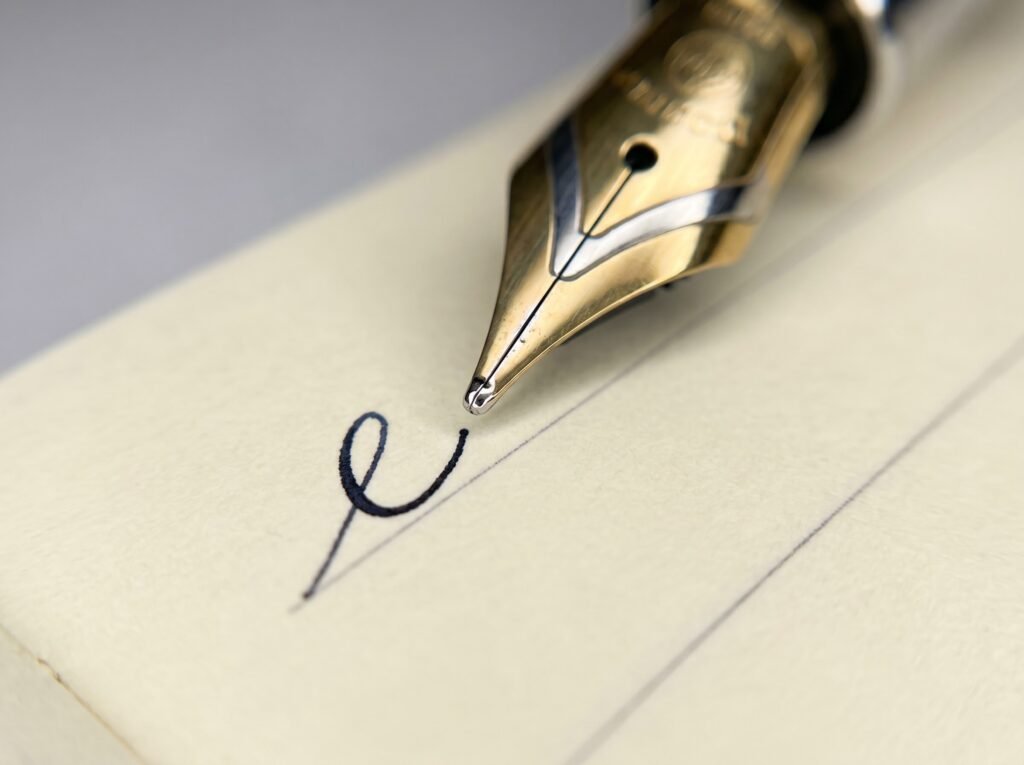
Every pen in our index is assessed against four criteria. Each criterion is scored on a 1 to 10 scale, and the composite score is the unweighted average. We do not hide the sub-scores: every review shows the grid.
| Criterion | What we evaluate | Common failure modes |
|---|---|---|
| Nib | Smoothness on paper, consistency of flow, accuracy of stated size, hard-start behavior out of the box, tipping quality under magnification | Scratchiness, baby-bottom (over-rounded tipping that skips), wide tine gap, misaligned tines, size labeled M that writes BB |
| Filling system | Ink capacity relative to price tier, ease of use, reliability of seal, converter/piston quality, clean-ability | O-ring failure, air-bubble-prone piston, proprietary cartridges with poor converter options, cheap converter that wobbles |
| Build quality | Material feel, cap seal (to prevent drying), clip durability, section comfort, posting behavior, finish longevity | Brittle plastic, loose cap that dries the nib overnight, sharp section edge, clip that breaks on first use |
| Value | Performance delivered per dollar at its price tier, not absolute price; a $30 pen earning an 8 and a $300 pen earning an 8 both represent strong tier-appropriate value | Nib quality identical to a pen at half the price, proprietary consumables that lock you into high-cost refills, discontinued filling parts |
A few points on the rubric before you use the index below.
We do not rate aesthetics. Color and design preference is personal. We only flag aesthetics when a design choice affects function (a cap that is too heavy to post comfortably, for example, affects balance and therefore the writing experience).
Nib size comparisons require care. Japanese nibs typically run one size finer than their Western counterparts. A Japanese M nib writes closer to a Western F. We note the actual line width in our individual reviews so the comparison stays honest across brands.
All pens are flushed with clean water before evaluation. New pens sometimes carry manufacturing residue in the feed that causes hard starts; flushing before the first fill is standard practice and removes that variable from our nib scoring.
The full review rubric (use it yourself)
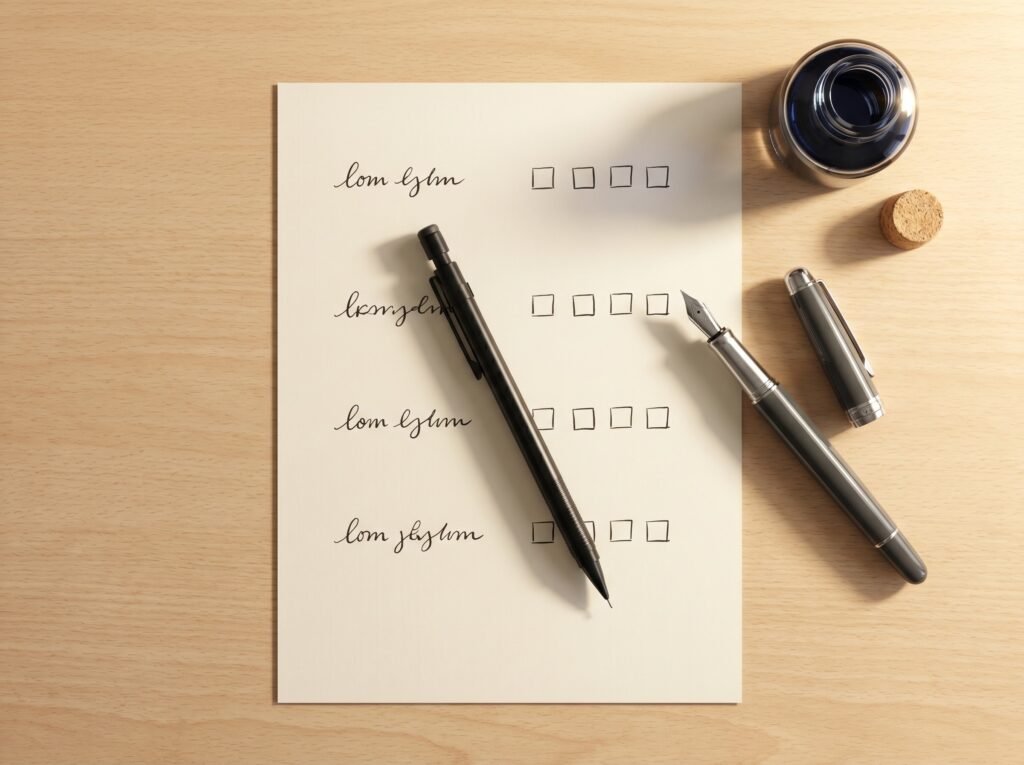
Below is the complete rubric we apply to every model. This is the living document our reviews are built from. Save it as your own evaluation checklist when testing a pen at a show or comparing notes online.
| Criterion | Sub-test | Score anchor: 10 | Score anchor: 5 | Score anchor: 1 |
|---|---|---|---|---|
| Nib | Smoothness on multiple paper types | Glides on cheap copy paper | Smooth on good paper, catches slightly on rough | Scratches on all tested papers |
| Nib | Flow consistency across writing speeds | Zero railroading at any tested speed | Rare skip at fast pace | Skips or floods unpredictably |
| Nib | Stated size accuracy | Line width within 0.05 mm of stated size | One sub-size off (Japanese M writing as F) | Two sizes off, no labeling explanation |
| Nib | Cold-start behavior (left uncapped for 30 minutes, then write) | Writes on first stroke | Writes on second or third stroke | Requires shake or coaxing |
| Filling system | Ink capacity (absolute, not just relative) | Above 1.5 ml usable | 0.7 to 1.0 ml | Below 0.5 ml with no upgrade path |
| Filling system | Seal quality (cap off overnight, writes?) | Writes immediately the next morning | Needs a few strokes | Dried to the point of needing a flush |
| Filling system | Clean-ability and disassembly | Fully flushable without tools | Requires converter removal | Requires specialized tool for basic flush |
| Build quality | Section comfort over 45-minute write | No hand fatigue, no sharp edges | Slight discomfort after 30 minutes | Fatigue or pain under 15 minutes |
| Build quality | Cap retention (posted and capped) | Secure both ways, no wobble | Secure capped, slight wobble posted | Cap falls off or does not post at all |
| Build quality | Finish durability (scratch, chip, fade) | No visible wear at 6 months of daily carry | Minor scratches, no chips | Finish chips or fades within weeks |
| Value | Nib quality vs. price tier peers | Best or tied-best nib at its price point | On par with peers | Clearly worse than cheaper alternatives |
| Value | Ink and part ecosystem cost | Uses standard international cartridges or takes any converter | Proprietary but converter available and reasonably priced | Proprietary with no converter option or eye-wateringly expensive refills |
Two quick notes on how we use this rubric. First, we note ink type in every review because the pairing matters: a wet nib suits a dry ink, and a dry nib suits a wet ink. Many Japanese nibs run on the dry side; many German nibs run wet. Pairing against the grain causes either flooding or skipping, and we do not penalize the pen for it. Second, we never mix shimmer inks into our evaluation inks because shimmer particles can lodge in fine and EF nibs. Shimmer performance is tested separately in pens with medium or broader nibs.
Review index by budget tier
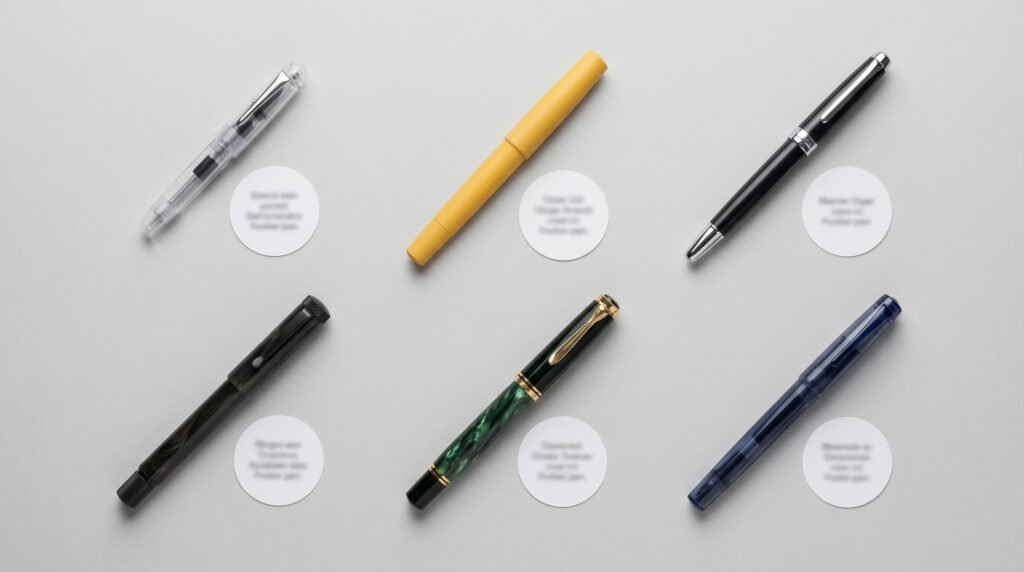
Use this table as a quick-reference map to the full reviews. Scores shown are the composite average from the four-criterion rubric. Click any model name to jump to its full review page.
| Budget tier | Model | Filling system | Nib options | Composite score | Best for |
|---|---|---|---|---|---|
| Under $30 | Kaweco Classic Sport | Cartridge (standard international) | EF, F, M, B, BB | Review in progress | Pocket carry, travel |
| Under $30 | Pilot Kakuno | Cartridge / converter | EF, F, M | Review in progress | Absolute beginners, children, gifting |
| Under $30 | Platinum Preppy | Cartridge / converter | EF, F, M, B | Review in progress | Fine lines, everyday low-cost writer |
| $30 to $50 | LAMY Safari | Cartridge / converter (Z28) | EF, F, M, B, LH | Review in progress | First serious pen, students |
| $30 to $50 | Pilot Metropolitan | Cartridge / converter | F, M, Stub 1.0 | Review in progress | Daily writer, office use |
| $30 to $50 | TWSBI Eco | Piston filler (built-in) | EF, F, M, B, Stub 1.1 | Review in progress | Ink enthusiasts, demonstrator fans |
| $50 to $150 | LAMY 2000 | Piston filler (built-in) | EF, F, M, B | Review in progress | Long-haul daily driver, minimalists |
| $50 to $150 | Platinum 3776 Century | Cartridge / converter | UEF, EF, F, M, B, C, Naginata | Review in progress | Gold-nib entry, Slip & Seal cap |
| $50 to $150 | Pilot Vanishing Point | Cartridge / converter | EF, F, M, B | Review in progress | One-handed uncapping, executive carry |
| $150 and up | Pelikan M800 | Differential piston filler | EF, F, M, B | Review in progress | Premium everyday writer, heirloom quality |
| $150 and up | Sailor Pro Gear | Cartridge / converter (REALO = piston) | EF, F, M, B and specialty cuts | Review in progress | Finest Japanese nib quality |
| $150 and up | Pilot Custom 823 | Vacuum filler | F, M, B | Review in progress | Maximum ink capacity, smooth long sessions |
Reviews marked “in progress” are being written and will populate with live scores as each article publishes. Scores will never be back-filled retroactively; the score you see reflects the pen’s condition and production quality at the time of evaluation.
Review index by use case
Some readers know their need before they know the model. This index maps common use cases to the reviews most relevant to each one. For deeper guidance on any category, the beginners guide and the per-tier buying guides expand on the reasoning behind each recommendation.
| Use case | Top picks (links to reviews) | Why these |
|---|---|---|
| First fountain pen | Kakuno, Safari, Metropolitan | Forgiving nibs, easy to clean, widely available ink ecosystems |
| Daily office or note-taking | Metropolitan, Safari, LAMY 2000 | Reliable starts, good ink capacity, professional enough look |
| Ink exploration (many ink changes) | TWSBI Eco, Vanishing Point | Piston or vacuum fillers; easy to flush and refill with different inks |
| Travel and pocket carry | Kaweco Sport, Metropolitan | Compact or slim profile, secure caps, reliable at altitude |
| Fine lines and journaling | Platinum Preppy EF, Platinum 3776 EF | Platinum nibs run consistently fine; Slip & Seal cap keeps fine nibs from drying |
| First gold nib | Platinum 3776, LAMY 2000 | Both carry 14K gold nibs at accessible price points; the 3776 uses cartridge/converter, the LAMY 2000 is a piston filler – pick the format that suits you |
| Premium or heirloom | Pelikan M800, Sailor Pro Gear | 18K and 21K gold nibs respectively, lifetime build quality, strong resale |
| Calligraphy and broad strokes | Safari LH nib, TWSBI Eco Stub 1.1 | Stub and italic cuts add line variation without needing a dedicated calligraphy pen |
Head-to-heads and comparisons
Side-by-side comparisons answer a different question than individual reviews. They exist to settle a specific decision: which of these two (or three) pens is better for me given my exact situation. Our head-to-heads use the same four-criterion rubric applied simultaneously to both pens with the same ink. This removes ink as a variable.
Published and in-progress head-to-heads:
- LAMY Safari vs. AL-Star: same nib unit, different body; which material justifies the price difference
- Safari vs. Metropolitan vs. TWSBI Eco: the classic beginner triad; one comparison settles most starter debates
- TWSBI Eco vs. 580: piston filler family; when the upgrade is worth it
- Pilot Metropolitan vs. Kakuno vs. Prera: Pilot’s three entry tiers compared directly
- Sailor 1911 vs. Pro Gear: same 21K nib, different body ergonomics
- LAMY 2000 vs. Pilot Custom 74: mid-range piston vs. gold-nib cartridge/converter
- Pelikan M200 vs. M400 vs. M800: the full Pelikan ladder in one article
What our reviews do not cover, and why
A fair review requires honest limits.
We do not evaluate pens with incompatible inks. India ink, traditional calligraphy ink, acrylic-binder inks, and dip-pen inks are not fountain-pen safe – their shellac or acrylic binders dry inside the feed and can cause permanent clogs. We use only inks specifically formulated for fountain pens.
We do not evaluate nib modifications in standard reviews. Minor micromesh smoothing to fix factory defects is noted when it occurs. But major nib work – spreading tines for flex, custom italic or stub grinds, or correcting a baby-bottom (where over-polishing rounds the tip into a ball that skips) – belongs to a professional nibmeister. Modifying a nib before reviewing it would make the score useless to a buyer who receives the pen unmodified from the box.
We do not rate vintage pens against the current production rubric. Vintage pens have their own considerations (latex sac integrity, ink compatibility, patina) and belong in their own evaluation framework. See our planned vintage series when it publishes.
For any pen we evaluate with an ink that has unusual properties (high pH, shimmer particles, iron gall), we note the ink and explain why it might affect the score. Noodler’s Baystate inks are always used in a dedicated pen and never mixed with other inks; we follow the same rule in our testing.
How to read a Nibhaven review score
A composite score of 8 or above means the pen delivers on its promise at its price tier. A score of 6 to 7 means it is decent but has a notable weakness worth knowing before you buy. Below 6 means the weakness outweighs the appeal and better options exist at the same price.
Scores are relative to price tier. An 8 on a $30 pen and an 8 on a $300 pen both mean “best-in-class for what it costs.” They do not mean the two pens write identically. A premium pen earns its higher score by delivering quality its cheaper sibling cannot match: the 18K gold nib on the Pelikan M800, the 21K gold nib on the Sailor Pro Gear, the differential piston mechanism Pelikan has refined for decades. The rubric makes these differences legible.
If you want to understand how any specific model fits into the broader landscape before reading its review, start with our brands overview, which places each manufacturer in context, or with our beginners guide, which narrows the field for anyone choosing their first pen.
Frequently asked questions
How often do you update review scores?
Scores stand unless a manufacturer makes a documented production change that meaningfully affects the criterion being scored. When we update a score, we note the reason and the date of the change at the top of that review. We do not silently revise scores.
Do you accept pens sent for review?
The Nibhaven team evaluates pens purchased independently or borrowed from community members. We do not accept sponsored review units. Our four-criterion rubric applies equally regardless of how a pen was acquired.
Can I suggest a pen for review?
Yes. Reach out through the contact page. We prioritize models with high search interest or genuine information gaps in the beginner-to-mid range. We do not review every suggestion, and we do not guarantee timelines.
Why do some review scores show “in progress”?
We publish the review index and rubric before all individual reviews are complete so you can use the hub and the rubric now. Scores populate as each full review publishes. This also prevents us from back-filling scores retroactively.
Read next
The Nibhaven team
We write plain-English fountain pen guides. Every claim is checked against the manufacturer documentation and primary sources listed above before publishing.