Fountain pens for beginners: everything you actually need to get started
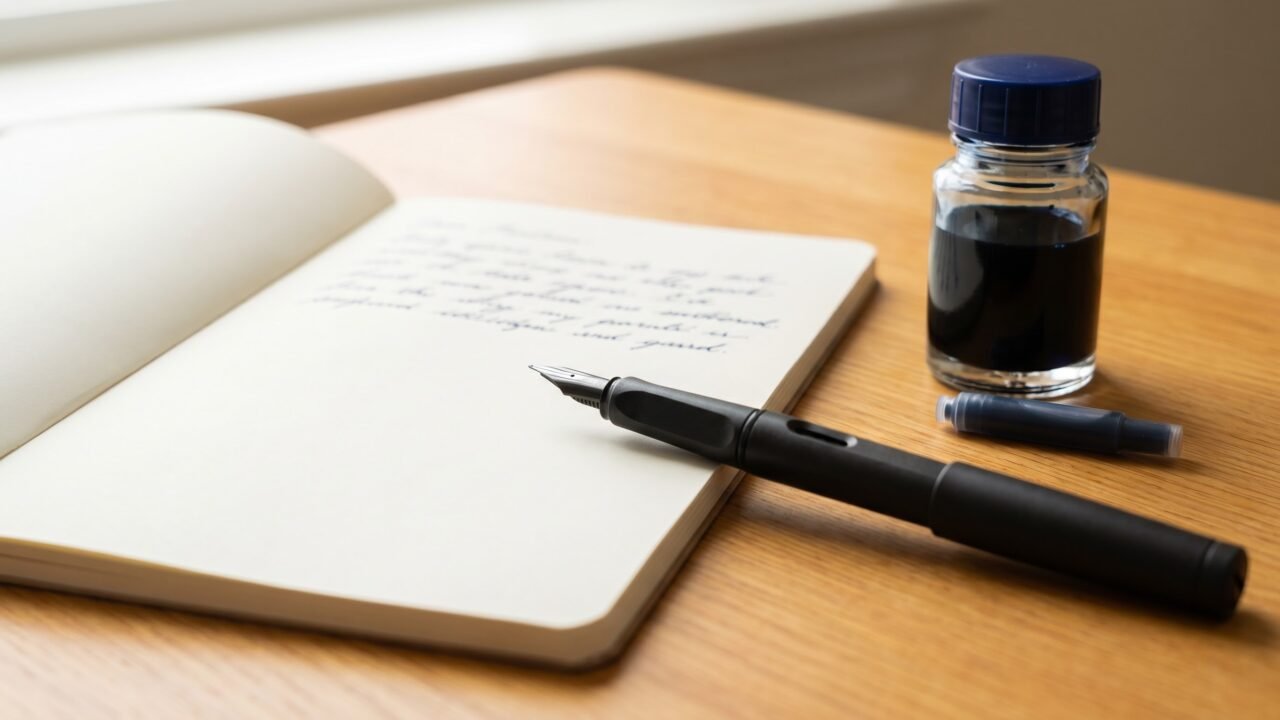
A fountain pen holds its own ink and feeds it to the writing tip using gravity and capillary action, so you never have to press down. That is the whole secret. The ink travels through a narrow slit in the nib, down through the feed, and onto the page the moment the tip touches paper. You guide the pen; the ink does the rest.
People love them because writing with almost no pressure feels genuinely different. Your hand relaxes. You slow down. The line responds to the angle you hold the pen, the wetness of the ink, the texture of the paper. There is real variety in that, and real satisfaction once you find a combination that feels like yours.
You do not need to be intimidated. The jargon is thick in fountain pen communities, but the actual mechanics are simple. A pen, an ink, a piece of paper. This guide walks through the five things that shape your experience, shows you the cheapest real starting points, and names the three mistakes that make beginners quit before they find their footing.
The five things that shape every fountain pen experience
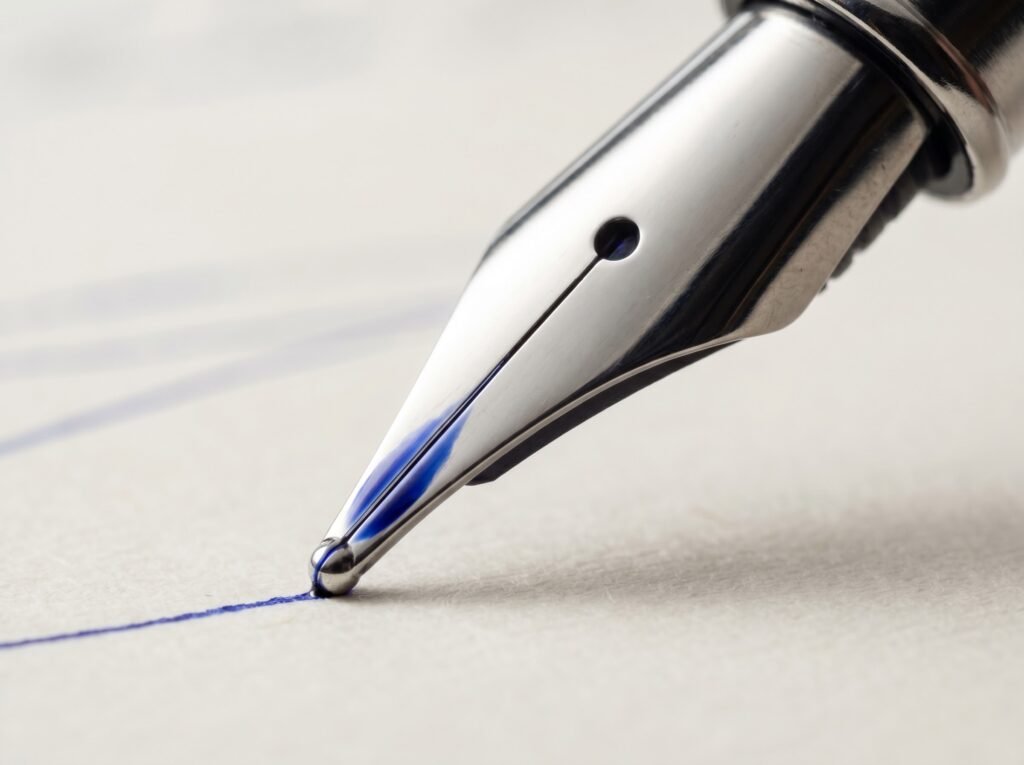
Every beginner question traces back to one of these five variables. Understand them and you can diagnose almost any problem on your own.
The pen
Entry-level pens start below $20 and write beautifully. The body material, filling system, and brand country of origin matter less than people argue. What does matter for a first pen is that it uses a standard cartridge or converter (so you can refill it easily), and that the nib is a medium or fine width. A medium writes a slightly wider line and tolerates minor inconsistencies in paper better. A fine is better for small handwriting. Both work.
Filling systems come in three types you will actually encounter as a beginner. Cartridge pens use disposable ink cartridges. Converter pens use the same slot but swap in a reusable converter you fill from a bottle. Piston fillers draw ink directly from a bottle via a built-in twist mechanism and hold more ink. For a first pen, cartridge or converter is simplest.
The nib
The nib is the metal tip, and its width controls the line thickness. Standard sizes run extra fine (EF), fine (F), medium (M), and broad (B). One thing trips up many beginners: Japanese nibs run roughly one size finer than Western ones. A Japanese medium writes closer to a Western fine. A Japanese extra fine produces a line around 0.3-0.4 mm; a Japanese fine (or equivalently, a Western extra-fine) produces closer to 0.5 mm. Pilot and Platinum use Japanese sizing. LAMY and most German brands use Western sizing. If you order a Japanese-brand pen in medium and find the line thinner than expected, that is why.
The nib is also the component that wears in over time. Modern nibs are tipped with extremely hard alloys, and with light pressure and compatible ink, a nib can last decades. For a deeper look at how sizes and shapes differ, our guide to fountain pen nib sizes covers every width and specialty cut in detail.
The ink
Use fountain pen ink. That sounds obvious, but it saves pens: India ink, calligraphy ink, dip-pen inks, and acrylic inks contain shellac or thick pigment binders that clog the nib and feed permanently. Use water-based fountain pen inks from any reputable brand and you will be fine. Enthusiasts widely report that iron gall inks, while beautiful, require regular use and thorough flushing because their acidic formulation can corrode steel nibs over time and damage the latex sacs in vintage pens. Shimmer inks (inks with metallic particles) work in medium and broader nibs but clog extra-fine and fine nibs consistently. For a first bottle, a plain dye-based ink in whatever color excites you is the right call. Our article on best beginner fountain pen inks has a short list of reliably well-behaved options.
The paper
Standard printer or copy paper causes feathering, which means the ink bleeds outward along the paper fibers and makes your writing look fuzzy. It also allows bleed-through, where ink soaks to the reverse side. The fix is paper treated to limit absorption while staying smooth. A paper weight of 80-100 grams per square meter helps, but the surface treatment matters more than the weight. Rhodia notepads and Clairefontaine notebooks are widely used starter options. Kokuyo Campus notebooks are affordable and widely available. If you do not want to buy specialty paper yet, look for a laser paper with a high smoothness rating rather than standard copier stock.
How you write
The single biggest technique adjustment is pressure. Fountain pens need almost none. Gravity and capillary action move the ink; pressing down adds nothing and damages the nib over time. A.T. Cross, the pen manufacturer, advises holding the pen at a 40-55 degree angle to the page and letting the pen’s weight do the work. If your writing feels scratchy, you are probably pressing. Lighten the grip and the scratchiness disappears.
The cheapest real starting point
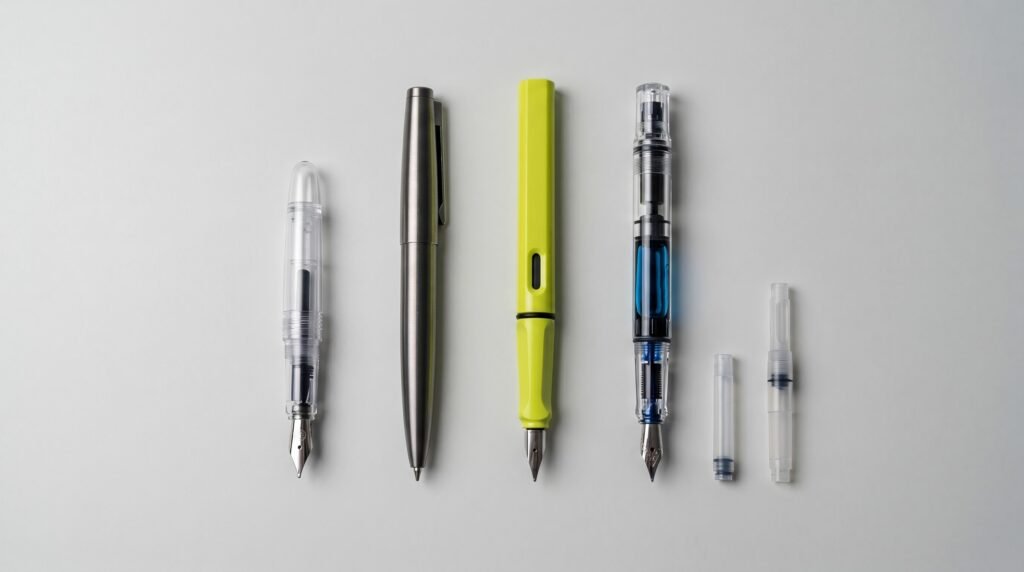
A real fountain pen means a refillable one with a proper nib, not a disposable. The range that covers nearly every beginner is $10 to $37.
| Pen | Price (approx.) | Filling system | Nib sizing | Best for | One honest caveat |
|---|---|---|---|---|---|
| Pilot Kakuno | ~$10-15 | Cartridge or converter | Japanese (runs fine) | First pen, younger writers, anyone who wants simple | Plastic body; looks casual |
| Pilot Metropolitan | $25-$34 | Cartridge or converter (converter compatible) | Japanese (runs fine) | First “serious” pen with a metal body | Fine is the narrowest standard option; verify smooth paper |
| LAMY Safari | $37 | Cartridge; converter sold separately | Western (A nib option for beginners) | Broader lines, left-handers, ergonomic grip | Converter is an extra purchase |
| TWSBI Eco | $37 | Piston filler (built-in) | Western | Bottled ink from day one; visible ink level | Piston needs occasional silicone grease |
The Pilot Kakuno and Pilot Metropolitan are the two most-recommended first pens among pen enthusiasts worldwide, mostly because their nibs write smoothly straight from the box and the price risk is low. The LAMY Safari’s “A” (beginner) nib is specifically designed to compensate for an untrained hand and write smoothly even under light pressure. The TWSBI Eco makes sense if you already know you want to use bottled ink, since the piston filler holds significantly more ink than a cartridge and lets you watch the level drop in the transparent barrel.
For more options across this price range, the full breakdown lives in our best fountain pens for beginners guide.
The decision path: which pen should you start with?
Rather than a long paragraph of conditions, here is a simple path through the main variables. Follow the branch that matches your situation.
| Your situation | Go here |
|---|---|
| Under $20 budget, just want to try a real fountain pen | Pilot Kakuno (F or M nib) |
| Around $25-$34, want a metal body that feels like a “proper” pen | Pilot Metropolitan (F or M nib) |
| Prefer wider lines, or left-handed | LAMY Safari (M or LH nib) |
| Want to use bottled ink from day one and see the ink level | TWSBI Eco (M nib) |
| Very small, precise handwriting | Pilot Metropolitan F, on smooth paper only |
| Unsure; want the safest possible start | LAMY Safari M, or the A nib which forgives beginner grip pressure |
Once you have one pen working well, the are fountain pens worth it piece is a good honest accounting of where the hobby gets more expensive and where it genuinely does not have to.
The three mistakes that make beginners quit
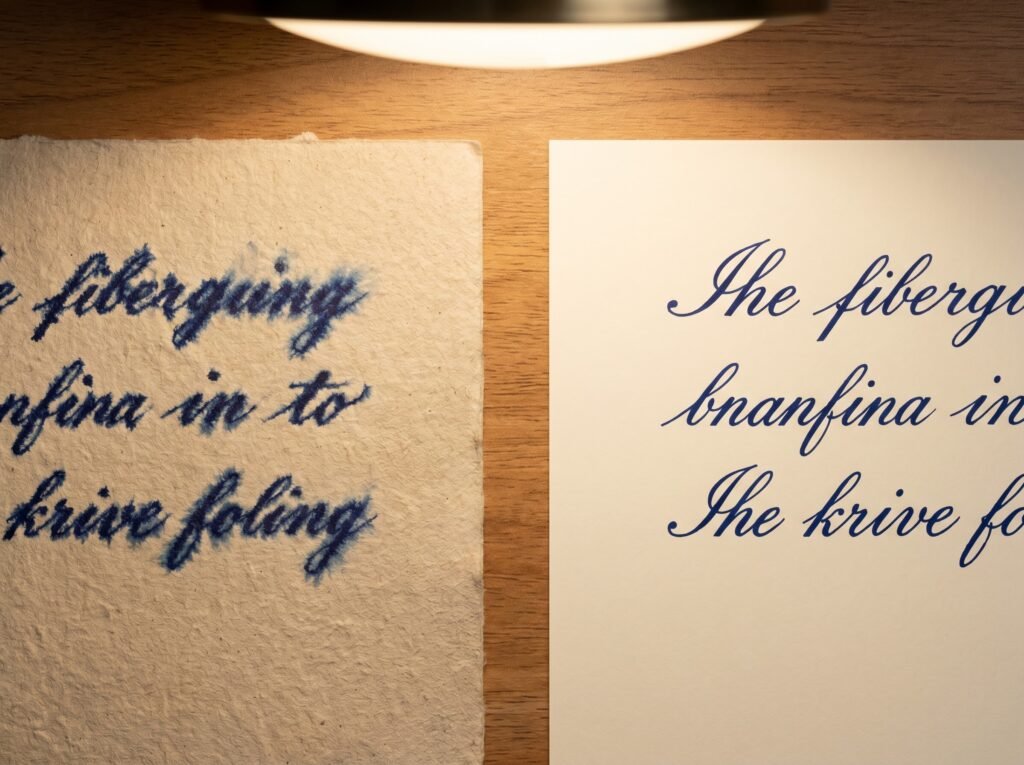
Most early frustration comes from one of three things, and all three are fixable in minutes.
Pressing down
This is the biggest one. Ballpoint and rollerball pens reward pressure; fountain pens do not. The ink flows the moment the nib touches paper. Pressing harder does not produce a darker or thicker line. It spreads the tines (the two prongs of the nib tip) slightly, which can cause skipping, and over time it can permanently misshape them. The fix: hold the pen loosely, let the nib sit on the paper under its own weight, and move your hand. The line appears. If it does not, the problem is not pressure.
Wrong paper
A pen that writes perfectly on Rhodia paper can look terrible on standard copier stock. The ink feathers into the fibers and bleeds through the page, and the beginner assumes the pen is broken. Try the same pen on a piece of smooth, heavier paper and the problem vanishes. Before concluding a pen writes badly, test it on at least two paper types. Inexpensive Rhodia staple-bound notepads are the fastest way to confirm whether a pen is the problem or the paper is.
Skipping a flush on a new pen
Brand-new fountain pens often have a light coating of machine oil on the nib and feed from the manufacturing process. This oil resists water-based ink and causes hard starts or patchy flow in the first few minutes of writing. The fix takes 90 seconds: before you ink the pen for the first time, run clean water through the nib section two or three times until it flows clear, then let it dry for a few minutes. Pen makers recommend distilled water, but tap water works for the initial flush. After that, the pen fills and writes normally.
For a full walkthrough on loading ink and writing technique, see our guides on how to use a fountain pen and how to write with a fountain pen.
A few things worth knowing about ink safety
Most fountain pen inks are simple water-based dyes and are interchangeable between brands. A few deserve a specific mention before you buy.
Noodler’s Baystate Blue and the other Baystate-series inks from Noodler’s must not be mixed with any other ink. Mixing triggers a high-pH chemical reaction that rapidly clogs the nib and feed – this is a practical hazard, not merely a loss of the ink’s distinctive character. The manufacturer states clearly that mixing also degrades the chemical properties that make these inks distinctive. Use them alone, and clean the pen thoroughly before switching to anything else.
Shimmer inks carry metallic or mineral particles that add sparkle to the line. They work well in medium, broad, and stub nibs. Extra-fine nibs clog reliably; fine nibs are also at risk and are not recommended. If you want shimmer, choose a pen with at least a medium nib.
Vintage pens with rubber sacs need extra care around iron gall inks. Iron gall inks are acidic, and their low-pH formulation can accelerate degradation of vintage rubber sacs and corrode metal parts over time if ink is left sitting in the pen. Modern formulations are more stable than historical ones, but the caution still applies to vintage hardware. For a first fountain pen, a standard dye-based ink avoids the question entirely.
Frequently asked questions
Do fountain pens leak on airplanes?
They can, because cabin pressure changes push ink toward the nib. The simplest fix is to fly with the pen either completely full or completely empty. A half-full pen is the riskiest state. Capping the pen tightly and carrying it nib-up reduces the chance of a leak significantly.
Can I use any ink in any fountain pen?
Any standard water-based fountain pen ink works in any modern fountain pen regardless of brand. The exceptions are India ink, calligraphy ink, dip-pen inks, acrylic inks (all will clog permanently), and Noodler’s Baystate-series inks (do not mix with other inks). Shimmer inks require medium or larger nibs.
How do I know when to clean my pen?
Clean it every one to two months if you use the same ink, or every time you switch inks. For cleaning, flush lukewarm water through the nib until it runs clear. Let the pen dry completely before refilling. If you store a pen inked for more than a few weeks, flush and re-ink it before using it again.
Is a $30-35 pen really good enough, or do I need to spend more?
A Pilot Metropolitan ($25-$34 depending on retailer) or a Pilot Kakuno (around $12-15) writes as well as many pens costing several times more. What more expensive pens offer is different nib characters, more filling system variety, and materials that feel or look premium. For learning to write with a fountain pen, an entry-level pen in the $10-37 range is genuinely sufficient. Many longtime enthusiasts still use entry-level pens daily.
Read next
The Nibhaven team
We write plain-English fountain pen guides and check every claim against manufacturer documentation and primary sources. Content is researched, AI-assisted, and human-reviewed before publishing.