How to clean a fountain pen: step-by-step guide for every filling system
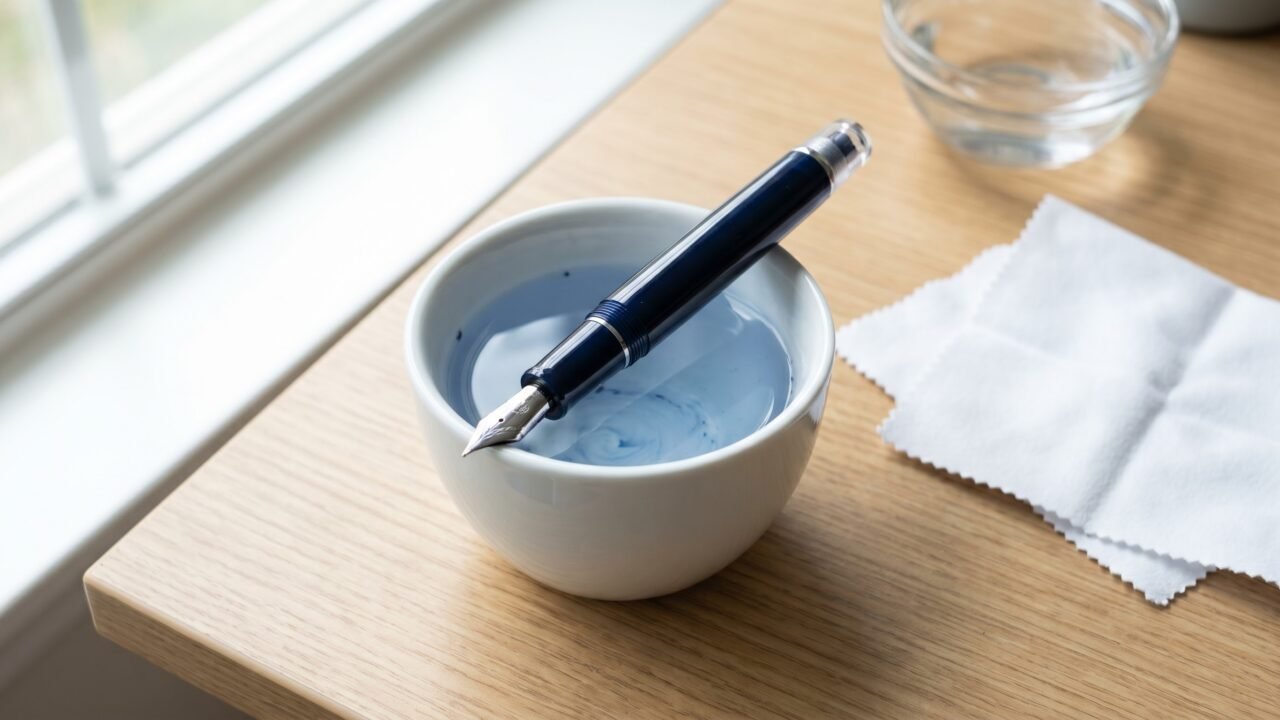
Cleaning a fountain pen comes down to one tool (water) and one motion (draw in, expel, repeat). For most pens, a thorough rinse under cool or lukewarm running water every four to six weeks – or whenever you change ink – keeps everything flowing. The steps differ slightly by filling system, the deep-clean triggers differ by ink type, and a handful of common mistakes can quietly damage a pen over time. This guide covers all of it.
If you just bought a new pen, flush it before your first fill. Manufacturing lubricants left in the nib assembly can cause hard starts and inconsistent flow. A quick rinse removes them.
What you need before you start
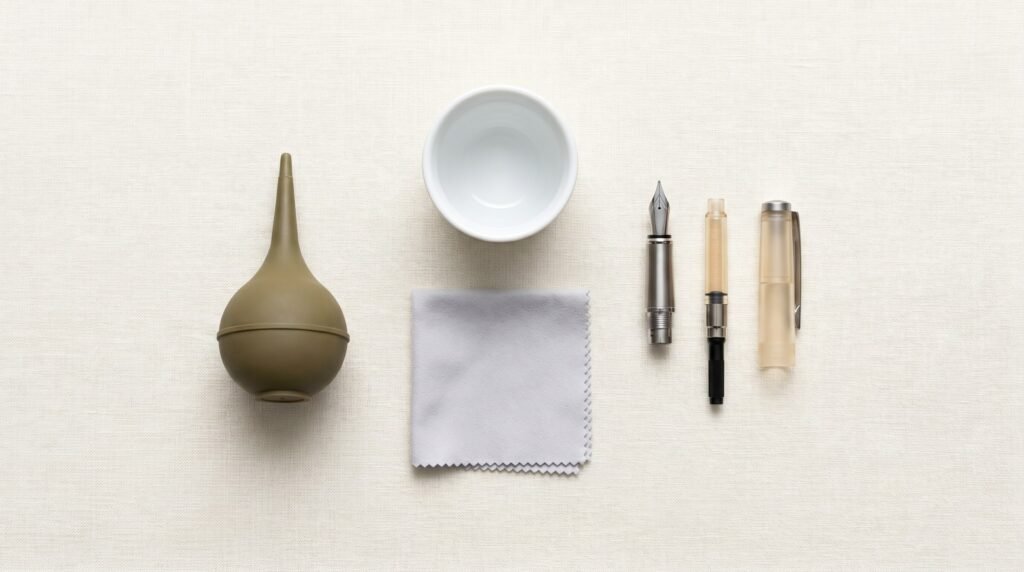
The list is short. Cool or lukewarm water is the primary cleaning agent; Pelikan’s official care documentation specifies lukewarm running water for routine maintenance and explicitly prohibits any soap or detergent additive for their piston pens, and Sailor’s care instructions also call for plain tap water. Never use hot water: it can warp plastic components and loosen barrel threads on acrylic and resin pens.
For a deeper clean when ink is stubborn or heavily pigmented, one small drop of mild dish soap in a cup of water is widely used. Pilot’s official cleaning guidance recommends exactly this for thorough sessions. Keep the amount minimal: excess soap residue in the feed is harder to rinse out than ink. Note that Pelikan piston pens are an exception: Pelikan’s official guidance prohibits any detergent or additive, so skip the dish soap entirely for Pelikan piston models and rely on repeated water flushes instead.
A rubber bulb syringe speeds things up considerably. It fits over the grip section and pushes water through the feed with more force than a converter alone can manage. You can clean any pen without one, but for piston fillers and heavily inked pens it cuts flushing time significantly.
A lint-free cloth or folded paper towel for blotting, and a small cup for soaking, round out the kit. That is genuinely everything.
Cleaning steps by filling system
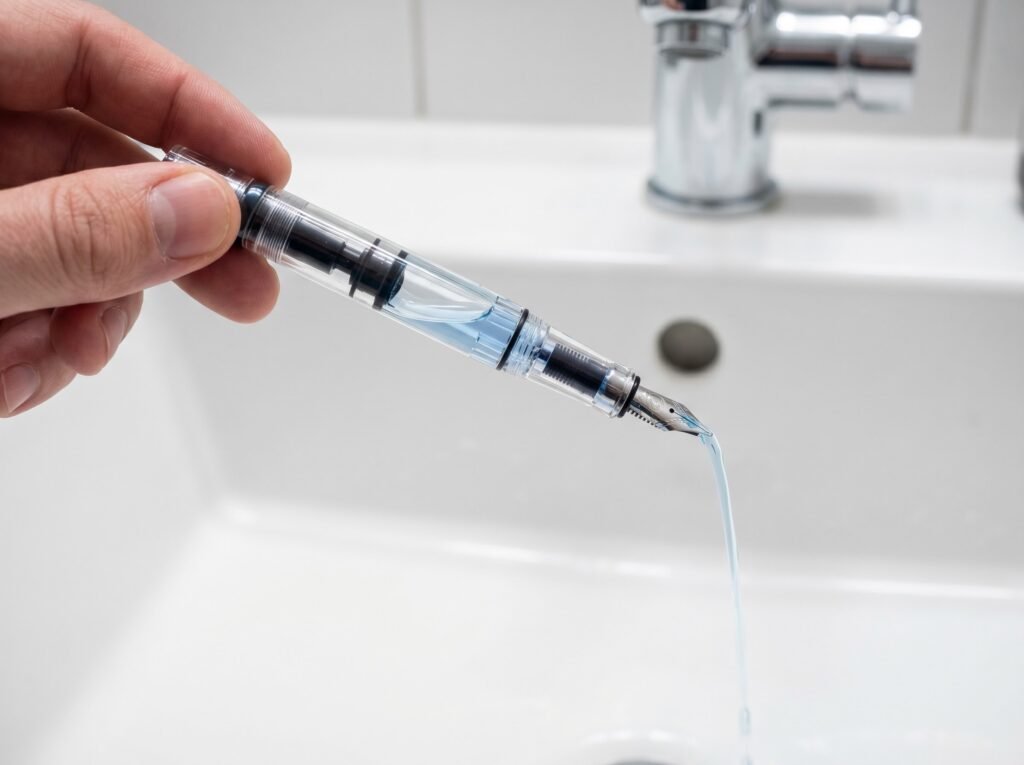
The mechanics differ depending on how your pen holds ink. The table below gives a quick reference; the sections that follow walk through each system in detail.
| Filling system | Disassemble? | Key cleaning method | Deep-clean access |
|---|---|---|---|
| Cartridge | Remove cartridge | Soak grip section; flush under tap | Bulb syringe on grip opening |
| Converter | Remove converter | Draw/expel water via converter; soak | Clean converter and grip section separately |
| Piston (built-in) | No disassembly needed | Draw/expel water via piston knob | Nib soak; flush barrel repeatedly |
| Eyedropper | Unscrew barrel from section | Rinse barrel; flush grip section | Bulb syringe on grip; soak nib section |
| Vacuum filler | Varies by model | Depress plunger to draw/expel water | Disassemble per manufacturer manual |
Cartridge pens
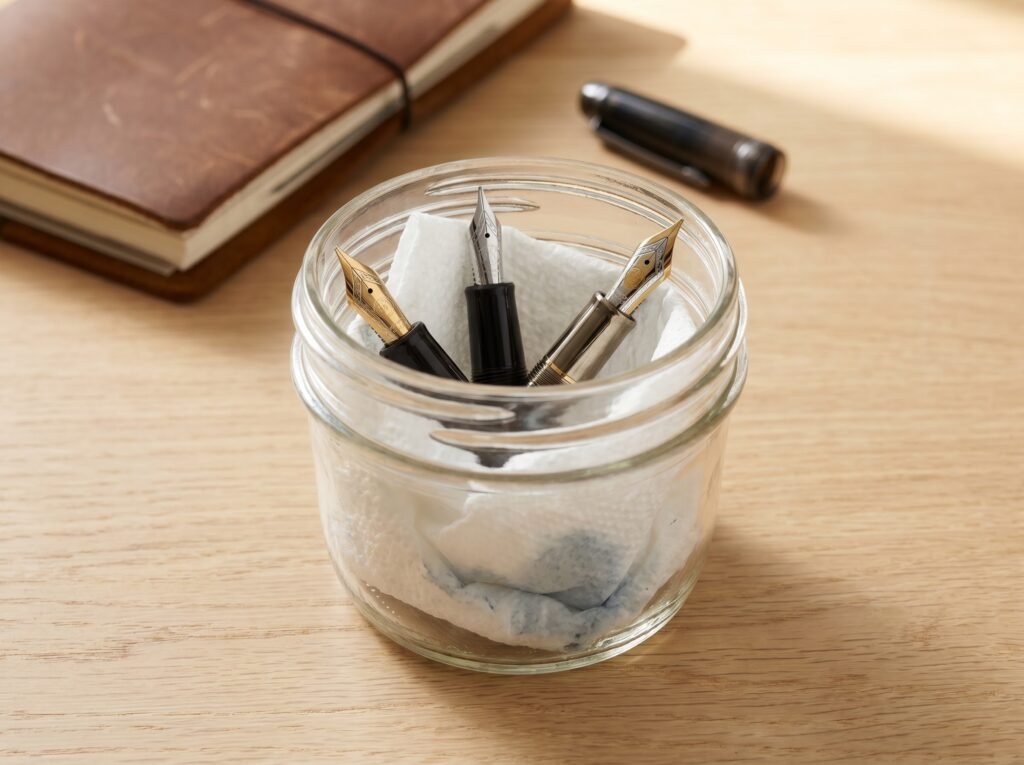
Pull off the cap, unscrew or pull apart the barrel, and remove the spent cartridge. Hold the grip section, the piece that holds the nib and feed, nib-down under cool running water and let water flow through for 20 to 30 seconds. Then place the grip section in a small cup of clean water, nib-down, and soak for 15 to 30 minutes. Lift it out, blot the nib gently on a paper towel, and let it air-dry nib-down in a cup for at least an hour before re-inking. Sailor’s official cleaning instructions follow this exact sequence for cartridge pens.
If ink residue is stubborn, add one small drop of dish soap to the soaking water and extend the soak to a few hours. Rinse thoroughly under plain water afterward to remove all soap.
Converter pens
Unscrew or pull the converter off the grip section. Flush the converter: fill it with clean water using the piston knob, shake gently, and expel. Repeat until the expelled water runs clear (usually three to five fills). Set the converter aside.
For the grip section, use a bulb syringe if you have one: press it firmly over the converter port and squeeze water through the feed several times. Without a syringe, submerge the nib in a cup of water and work the grip section up and down gently to draw water through the feed. Soak for 15 to 30 minutes, then rinse and blot dry. Sailor’s care guide recommends drawing and expelling water through the converter five to six times, followed by an overnight soak of the nib section for a thorough clean.
For more detail on how converters work and which styles suit which pens, the article on how to fill a fountain pen converter covers the different converter types and their mechanics.
Built-in piston pens
Piston-fill pens like the Pelikan M series, LAMY 2000, and TWSBI Diamond 580 hold the ink directly in the barrel, with no separate converter to remove. Pelikan’s official guidance – covering both their FAQ and their Refills and Care page – states that cleaning these pens requires only clear water. Pelikan explicitly prohibits soap or any other additive: “Never use additives such as liquid soap or detergents to clean your pen!” This is a hard rule, not a soft preference, so dish soap deep-cleans that work fine for other brands are not appropriate for Pelikan piston pens.
Expel any remaining ink by twisting the piston knob so the barrel empties. Hold the nib under cool running water and twist the piston clockwise to draw in a barrel of clean water. Twist counterclockwise to expel. Repeat four to six times or until the expelled water is clear. For a more thorough session, fill the barrel with plain water and let it sit for 15 minutes before expelling and repeating. Dry by placing the nib section in a cup nib-down for several hours, or blot and allow 12 to 24 hours before re-inking.
Eyedropper pens
Eyedropper pens are filled by drawing ink directly into the barrel with a dropper: no converter, no piston. Unscrew the barrel completely from the grip section. Rinse the barrel under running water, then fill it with clean water, cap the opening with a finger, shake, and empty. Repeat two or three times.
Flush the grip section and nib using a bulb syringe or by soaking nib-down in clean water. When you re-ink an eyedropper pen, apply a fresh thin layer of silicone grease to the threads where the barrel meets the grip section. This creates the airtight seal that prevents leaks; skipping it is the most common assembly mistake with this filling system. For a full overview of how eyedroppers compare to other filling methods, see the guide to fountain pen filling systems.
How to deep-clean when a routine flush is not enough
A routine water flush handles most cleaning jobs. A few situations call for something more.
Add a single drop of mild dish soap to lukewarm water and soak the nib section for two to four hours when: the pen has sat inked and unused for several weeks, the ink in use is heavily pigmented or pigment-based, or you are switching from a dark saturated ink to a light pastel. Exception: if you own a Pelikan piston pen (M200, M400, M600, M800, M1000, or similar), skip the dish soap entirely – Pelikan’s official guidance explicitly forbids any detergent or additive for their piston models. Use plain water flushes only and extend the soak time instead.
For shimmer inks specifically, the mica particles that create the sparkle effect settle in the feed channels during any pause in writing. A bulb syringe flush after expelling the ink, followed by a 30-minute soak, is usually enough to clear them. Keeping shimmer ink in a fine or extra-fine nib for extended periods is not recommended: the narrow channels are exactly the geometry where mica accumulates fastest. The article on shimmer ink safety covers which nib sizes carry lower clog risk and how to maintain those pens week to week.
Iron gall inks deserve special mention. They contain iron salts and tannic acids that can cause flash corrosion on metal parts and deposit ferro-gallic residue in feed channels if left to dry, according to the Wikipedia entry on iron gall ink. Modern iron gall inks formulated for fountain pens are far milder than historical dip-pen formulas, but the cleaning rule is the same: flush more frequently and never leave iron gall ink sitting in a pen for weeks at a time. A dilute dish soap solution (two to three milliliters of dish liquid in 10 to 15 milliliters of water) is effective for iron gall residue per Ink Journal’s iron gall guidance. For a full treatment of safe iron gall use, the iron gall ink guide on this site goes through the practicalities.
Vintage pens with rubber latex sacs need extra care. High-pH and heavily acidic inks, including some iron gall formulations, can degrade the latex over time. If you own a sac-fill vintage pen and are unsure when the sac was last replaced, treat ink choice conservatively until the pen has been serviced.
One more specific case: Noodler’s Baystate Blue and other Baystate-line inks must not be mixed with any other non-Baystate ink. The formulation is chemically distinct and an undesired reaction (including rapid clogging) results from mixing. Flush a pen completely with plain water before switching into or out of Baystate ink, and keep the pen dedicated if you use it regularly.
How often to clean a fountain pen
Every four to six weeks is a reasonable default for a pen in regular daily use. Change that to “every time you switch inks” regardless of interval. For shimmer inks, every one to two weeks is the sensible upper limit. Iron gall inks warrant flushing every two to three weeks, or more often if you write infrequently.
Sailor’s care guide recommends cleaning every two to three months even for pens in regular use. To be plain about what that means: Sailor frames two to three months as the minimum floor for a pen that is actively written in every day – not the ideal target cadence. If your pen sits unused for stretches, or if you use more demanding inks, cleaning more frequently than Sailor’s floor is the right call. The four-to-six-week default is the rhythm most manufacturers and the wider fountain pen community converge on for real-world daily use. Pelikan specifies that for pens in daily use a once-yearly thorough rinse may suffice, though that assumes consistent daily writing that keeps ink flowing and fresh.
The question of exactly when and why cleaning frequency matters is covered in detail in the article on how often to clean a fountain pen.
What not to do
A few mistakes come up repeatedly, and some are genuinely damaging rather than just inefficient.
Hot water. Cool to lukewarm is the consistent manufacturer recommendation. Hot water softens and can warp acrylic, resin, and celluloid components. It can also loosen barrel threads and damage pressure-fit sections.
Alcohol. Isopropyl and rubbing alcohol degrade rubber seals, acrylic, and resin over time. Sailor’s care page explicitly warns against alcohol-based cloths on pen bodies. Some ebonite hard rubber pens are somewhat more tolerant, but the safe rule across all materials is to avoid alcohol entirely for routine cleaning.
Ultrasonic cleaners. These are fine for metal nib units and hard-to-clean feeds when used carefully, but the vibration can stress celluloid and some older plastics. If you are not certain of your pen’s material, skip the ultrasonic option.
India ink, acrylic ink, or calligraphy ink. These are not fountain pen inks. India ink and acrylic inks dry hard and will clog a feed permanently. Dip-pen calligraphy inks are often similar. Use only inks specifically formulated for fountain pens.
Blowing hard into the nib. Air pressure introduced from the nib end can push dried residue further into the feed or crack a delicate nib on an older pen. Use a bulb syringe from the grip opening instead, pushing water through from the ink side toward the nib.
Soaking a transparent or color-translucent nib section overnight. Sailor’s care instructions flag this specifically: prolonged water contact can discolor translucent materials. A one-hour soak is safe; overnight is not necessary for most cleaning jobs and risks staining clear acrylics.
Getting water on a wooden barrel. Wooden barrel pens need the nib and grip section cleaned normally, but the barrel itself should stay dry. Water causes wood to expand and crack.
Owned reference: per-system cleaning steps at a glance
The table below consolidates the step sequences for each filling system. It is designed as a quick checklist to have open while you clean.
| Step | Cartridge | Converter | Built-in piston | Eyedropper |
|---|---|---|---|---|
| 1 | Remove cartridge | Remove converter | Expel ink via piston knob | Unscrew barrel from grip |
| 2 | Rinse grip section under cool tap (30 sec) | Flush converter (fill/expel x3-5) | Draw clean water into barrel via nib | Rinse and shake barrel x3 |
| 3 | Soak grip section nib-down (15-30 min) | Flush grip section: bulb syringe or soak | Expel water; repeat 4-6x until clear | Flush grip section: bulb syringe or soak |
| 4 | Blot nib, air-dry nib-down | Blot; air-dry both parts separately | Blot nib; air-dry nib-down 12-24 h | Blot; apply silicone grease to threads |
| 5 | Insert fresh cartridge or converter | Reassemble; fill with ink | Fill with ink via nib | Fill barrel with eyedropper; reassemble |
| Deep-clean trigger | Ink dried in pen; heavy pigment; long storage | Color switch; shimmer; iron gall | Visible discoloration; sluggish flow | Color switch; any pigment ink |
For a deep clean, add one drop of mild dish soap to the soaking water at step 3 and extend the soak to two to four hours. Rinse with plain water at step 4 before blotting and drying.
Frequently asked questions
Can I use pen flush instead of water?
Yes. Commercial pen flush solutions (such as those from Platinum, TWSBI, or Monteverde) are designed for fountain pens and are safe for all standard materials. They are useful for stubborn dried ink or pigment residue. For routine maintenance, plain cool water is sufficient and costs nothing.
My pen has been sitting inked for months and the nib is dry. What do I do?
Soak the nib and grip section in a cup of cool water for several hours, or up to 24 hours for severely dried ink. Change the water once or twice. Do not force the nib or piston. Most dried water-based inks dissolve with patience. A drop of dish soap in the water speeds this up. Pigment-based inks may need a commercial pen flush.
Do I need to clean a brand-new fountain pen before using it?
Manufacturers widely recommend it. Factory lubricants and releasing agents can remain in the nib assembly and cause hard starts or inconsistent ink flow. A quick rinse under cool water before the first fill takes about two minutes and prevents the frustration of a new pen that writes poorly on its first day.
How do I know when the pen is clean enough to re-ink?
When the water expelled from the pen runs completely clear with no color at all, the pen is clean. Blot the nib on a white paper towel: if no ink color transfers, you are ready. Allow the nib section to air-dry for at least an hour before refilling. For best results, wait 12 to 24 hours, especially before switching to a light-colored or pH-sensitive ink.
Read next
The Nibhaven team
We write plain-English fountain pen guides and check every claim against manufacturer documentation and primary sources. Content is researched, AI-assisted, and human-reviewed before publishing.