Fountain pen brands: a practical map of who makes what and who each brand is for
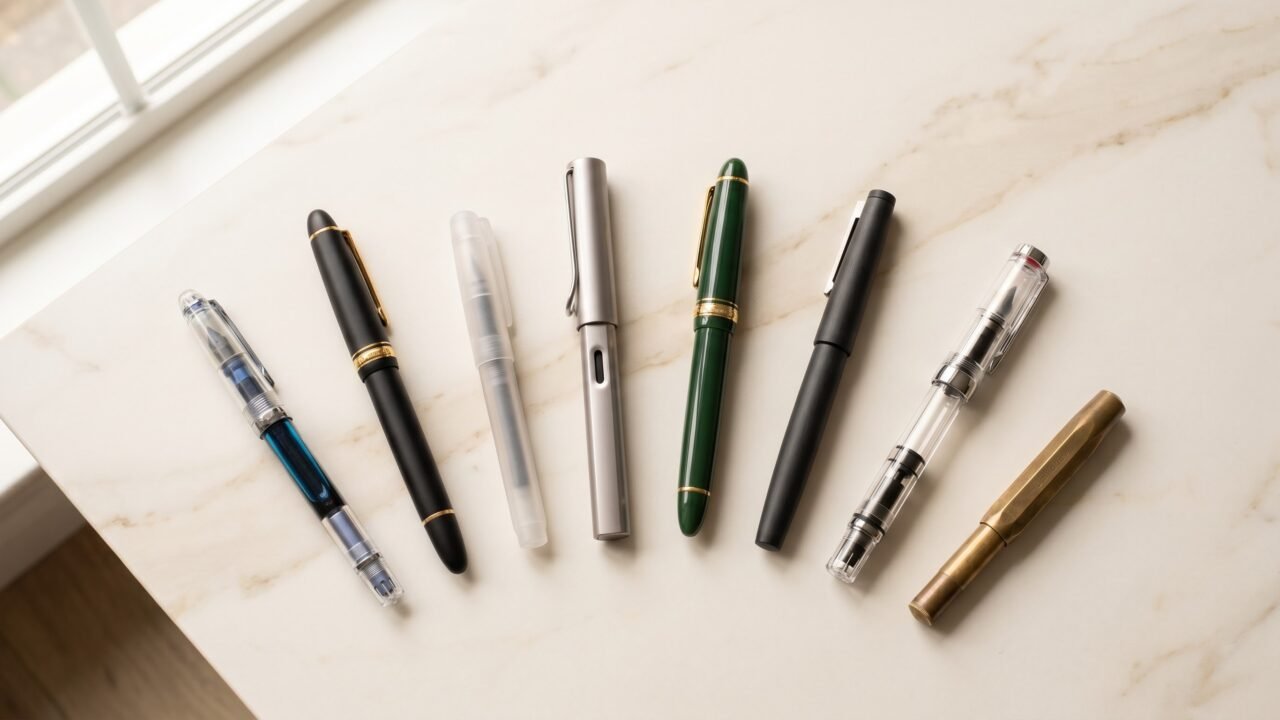
There are roughly a dozen major fountain pen brands that matter to most buyers, plus a handful of heritage names and a growing group of affordable Chinese makers. Knowing who makes what saves you from spending $300 on a pen when a $37 one would suit you better, or passing on a great option just because the name is unfamiliar. This guide covers 16 brands, groups them by price and writing character, and links to deeper comparisons on Nibhaven where they exist.
One fact shapes every brand comparison: Japanese nibs run about one size finer than Western ones, especially at EF and F. A Japanese F writes at roughly the line width of a Western EF, and a Japanese M is close to a Western F. The brands below divide roughly along that line, so this difference matters before you order anything.
The Japanese Big Three: Pilot, Sailor, Platinum
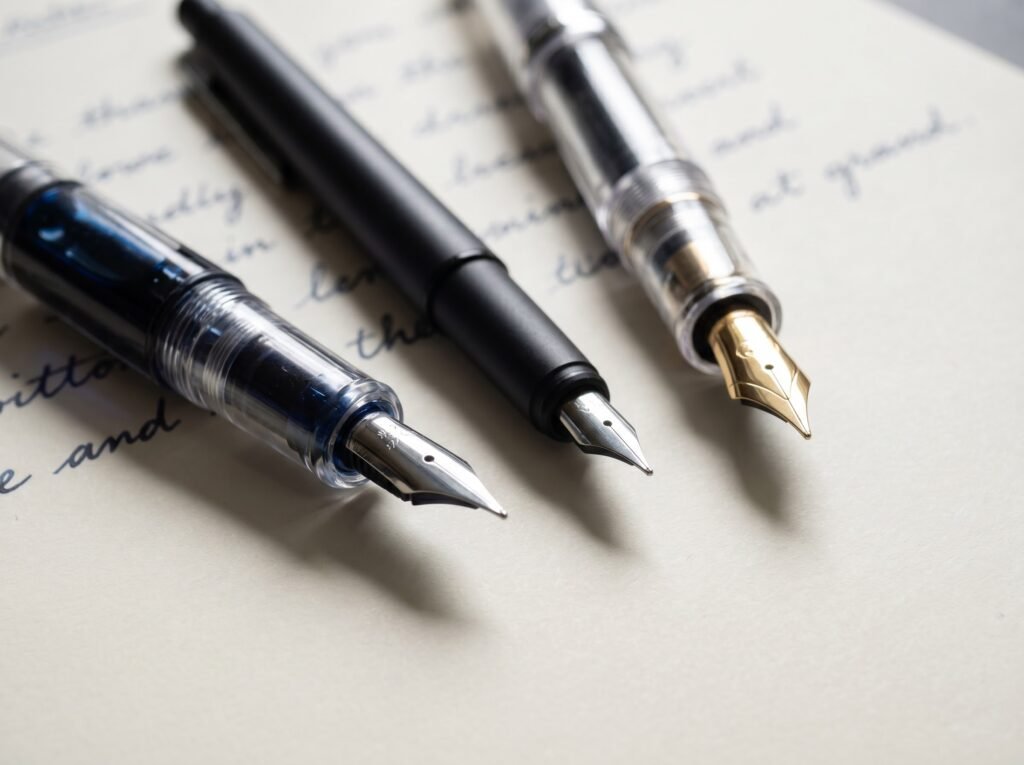
Japan’s three dominant pen makers are in a league of their own for nib precision, ink-management engineering, and value at every price tier.
Pilot is the most accessible of the three. The Kakuno (around $15) is a student pen with a smiley-face mark on the nib that keeps you oriented while writing – with Japanese pens, nib alignment matters more than with most Western ones. The Metropolitan (~$25) is one of the best steel-nib pens at any price in that range. Step up to the Custom 74 (~$176) and you get a 14k gold nib plus specialty options like Soft Fine and Music. At the top sits the Vanishing Point, a capless retractable pen with an 18k nib, and the Namiki sub-brand: Pilot’s hand-lacquered maki-e line, where nibs are made entirely in-house and prices reach into the thousands. Pilot nibs tend to run dry, which pairs well with wetter inks.
Sailor is the nib enthusiast’s brand. The flagship 1911 and Pro Gear lines carry 21k gold nibs, an unusually high gold content that gives Sailor nibs a distinctive spring and snap. The specialty nib options are hard to find anywhere else: the Music nib (three tines for calligraphy-style line variation), the Zoom (a broad cursive nib that changes width with writing angle), and the Naginata Togi (a cross-cut grind that shades differently depending on direction). Standard 1911 models run around $150-250 depending on where you buy; specialty-nib versions add roughly $50 to that. For a close look at how Sailor’s nib character compares to Pilot and Platinum, our head-to-head covers the key differences.
Platinum is the quiet engineer of the three. The Preppy ($5-8) is one of the best fountain pens under $10; its steel nib is modular and swappable across the Plaisir and Prefounte bodies. The flagship 3776 Century (around $100-180 at US retail) has a 14k gold nib and Platinum’s patented Slip & Seal inner cap, which keeps ink from drying even if the pen sits unused for up to two years. The name “3776” comes from the height of Mount Fuji in meters. Platinum nibs produce a crisp, clean line and tend toward the precise end of the Japanese spectrum.
The German school: LAMY, Pelikan, Kaweco
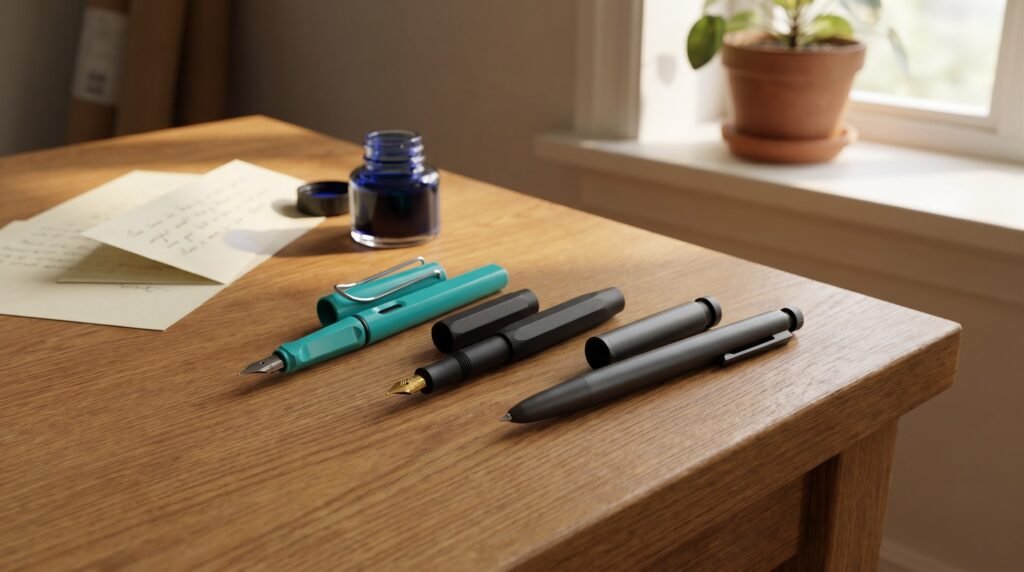
German engineering favors wet flow, firm feedback on the page, and longevity. German nibs generally run a half to full size broader than Japanese equivalents at the fine end.
LAMY built its reputation on the Safari: a triangular-grip, swappable-nib, ABS plastic pen that has been the world’s best-selling fountain pen for years. It sits around $30. The AL-Star ($47, from Lamy’s official US shop) is the same pen in anodized aluminum, lighter and colder to the touch. Both use interchangeable steel nibs in sizes EF through Broad plus calligraphy stubs. Lamy’s modular nib system means one pen body can wear different nibs as your skills grow. At the top of the LAMY line is the 2000 ($279, official US price): a 1966 Bauhaus design by Gerd A. Müller that has not changed since its launch, with a fiberglass body, integrated piston, and a 14k gold nib with platinum coating. It has won the German Design Award, the iF Industrie Forum Design, and the red dot Design Award.
Pelikan is the piston-filler purist’s brand. The Souveran line runs from the M200 (steel nib) through the M400 and M600 (14k gold) to the M800 and M1000 (18k gold). The M800 retails around $740-925; the M1000, Pelikan’s flagship at 146mm closed and 33 grams, sits at the top of the premium tier. Every Souveran is defined by its piston mechanism and the striped cellulose acetate barrel. Pelikan nibs are springy at the higher grades and reliably wet, which makes them a good match with drier inks and fine papers.
Kaweco is the pocket pen brand. The Classic Sport was first designed in 1911, fits 10.5 cm capped, and transforms into a full-size pen when the cap is posted. Nibs are manufactured by Bock in Germany. The Classic Sport starts at €24.95 on Kaweco’s official site; a piston-filler version runs €64.50. Materials scale from plastic to aluminum (AL-Sport) to brass, heavier at each step, prized by those who want more weight in a small form factor. For anyone drawn to the Sport’s character versus Lamy’s, our four-way comparison has direct notes on feel and use case.
The Taiwan value pick: TWSBI
TWSBI (pronounced “twiz-bee”) was founded in 2009 as a spin-off from Ta Shin Precision, a Taiwanese OEM manufacturer. The name comes from “San Wen Tong” (Hall of Three Cultures) with “Bi” – meaning writing instrument – added at the end. The brand’s focus: piston-filling demonstrators at prices that rival cartridge pens.
The ECO ($36.99 at twsbi.com) is a piston filler with a clear body, an inner-cap seal, and steel nibs in EF, F, M, B, and Stub 1.1. It holds more ink than most cartridge-converter pens that cost two or three times as much. The Diamond 580 ($55-89 depending on variant) uses an aluminum internal mechanism and a larger steel nib for smoother flow. TWSBI pens can be fully disassembled and cleaned without tools, which makes them popular with ink experimenters. They run wetter than most Japanese pens and slightly wetter than LAMY; they work well with standard medium-weight inks. For a direct comparison against the Safari and Metropolitan, our three-way review walks through every scenario.
Heritage Western brands: Montblanc, Parker, Waterman, Sheaffer
These four brands are where fountain pens were codified in the West. Their modern lineups vary widely in where they land on value.
Montblanc launched the Meisterstück (“Masterpiece”) line in 1924. The 149 model arrived in 1952 and has changed almost nothing since: a large cigar-shaped pen with an Au750 (18k) gold nib, available in EF through Broad. The 149 costs $1,270 at Montblanc’s US retail site. You are paying for the history, the handcraft, and the signal the pen sends. The writing quality is exceptional, but at this price it is also a luxury object first.
Parker is best known for the iconic Parker 51, introduced in 1941. Modern Parker is now part of Newell Brands. The Sonnet carries an 18k gold nib (17 parts, hand-assembled) and runs $250-400 depending on finish. The Jotter, at the very affordable end, uses a steel nib and works as a daily writer. Parker nibs are reliable, Western-width, and medium-wet.
Waterman traces to L.E. Waterman, who patented a reliable ink-feed system in 1884 and helped turn the fountain pen into a practical writing tool. The brand is now French. The Hemisphere has a steel nib; the Expert offers a stainless steel nib and suits business use at roughly $170-220; the Carene carries an 18k gold nib and costs $350-730. Waterman designs are understated by luxury-pen standards: slim, balanced, and European-office in character.
Sheaffer was founded in 1912 and is credited with introducing the lever-fill system to fountain pens, a filling method that became widely adopted. The modern 300 series uses a steel nib, cartridge-converter fill, and comes in under $100. Newer production has shifted to Italy and China depending on tier. Sheaffer’s design markers – the white dot on the cap and the slotted clip – remain visually distinctive.
Budget Chinese brands: Jinhao, Hero, Wing Sung
Chinese fountain pens have moved from curiosities to genuine daily writers. The best of them punch far above their price tags.
Jinhao is the name most enthusiasts encounter first. The X159 (around $6-8) is an open homage to the Montblanc 149’s proportions, with a large steel nib and cartridge-converter fill. The X350 is a metal-body pen at 32 grams that writes better than its price suggests. Jinhao nibs vary by unit: some are excellent out of the box and some need a gentle adjustment, but at these prices even a modest nib is a fair deal. For a guided tour of what to expect from the best budget fountain pen brands, we cover Jinhao alongside other value picks in detail.
Hero is Shanghai’s historic pen maker, founded in 1931 as the Wolff Pen Manufacturing Company and renamed in 1966. The Hero 100 is derived from the Parker 51 and has been in production since 1958 with little structural change. Hero pens are priced under $20 and are a genuine slice of Chinese pen history.
Wing Sung is a Chinese pen brand with decades of production history. The Wing Sung 698 is a piston filler with a nib and feed reported by enthusiasts to be compatible with Pilot nib units, which means nib swapping between the two brands is possible. At under $15, it is one of the best piston-filler values available at that price.
Brand positioning matrix: price vs writing feel
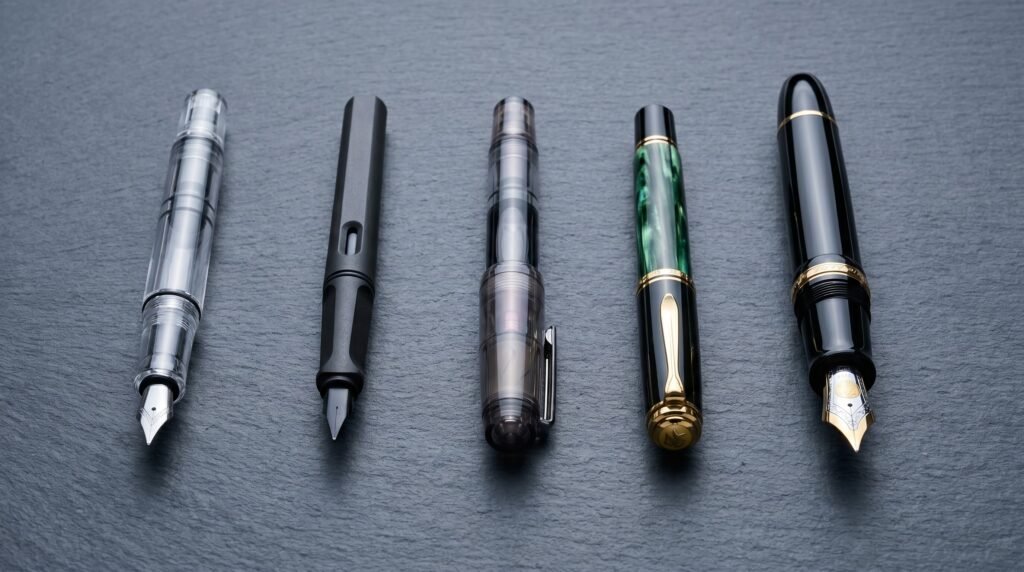
The table below maps all 16 brands on two axes: approximate entry price for a functional pen (not the cheapest possible cartridge pen, but a pen that represents the brand’s character) and nib feel (the writing sensation from dry-and-firm to wet-and-soft). These are general tendencies; individual models vary.
| Brand | Entry price (approx.) | Nib character | Best fit for |
|---|---|---|---|
| Jinhao | $6-10 | Variable, medium-wet | Trying fountain pens for the first time |
| Wing Sung | $10-15 | Dry-to-medium, Pilot-like | Budget piston-fill experimenter |
| Hero | $10-20 | Medium, vintage character | History enthusiast, daily carry cheap |
| Pilot Kakuno | ~$15 | Dry, fine line | First Japanese pen, students |
| Platinum Preppy | ~$8 | Dry, very precise | Cheap first Japanese pen, note-takers |
| LAMY Safari / AL-Star | $30-47 | Medium-wet, firm Western | Everyday writer, swappable nibs |
| TWSBI ECO | $37 | Medium-wet, smooth | Ink explorer, high-volume writer |
| Kaweco Classic Sport | ~$27 (USD equiv) | Wet, firm feedback | Pocket EDC, traveler |
| Pilot Metropolitan | ~$25 | Dry-to-medium, smooth | Best steel-nib daily in this range |
| Platinum 3776 Century | ~$120 | Dry, crisp, precise | Gold-nib Japanese precision seeker |
| Pilot Custom 74 | ~$176 | Dry-to-medium, soft flex options | Mid-range Japanese gold-nib upgrade |
| Sailor 1911 / Pro Gear | ~$150-250 | Dry, springy, precise | Nib connoisseur, specialty-nib lover |
| LAMY 2000 | $279 | Medium-wet, smooth, soft gold | Bauhaus design lover, lifelong writer |
| Pelikan Souverän M400/M800 | ~$300-925 | Wet, springy gold | Piston-fill devotee, desk anchor |
| Parker Sonnet / Waterman Carene | ~$250-730 | Medium-wet, classic Western | Professional desk pen, heritage buyer |
| Montblanc 149 | $1,270 | Wet, soft, large | Luxury object, status, heirloom |
How to use this map to make a decision
Start with budget, then choose Japanese or Western. Japanese nibs are finer at EF and F; Western nibs are fuller and wetter at those sizes. If you write small and want a fine line, Japanese brands reward you. If you prefer a bolder stroke and wetter flow without hunting for wet inks, lean German.
Within Japanese brands: Pilot has the widest entry ramp, Platinum has the best engineering novelty (Slip & Seal), and Sailor is where you go when you’ve used the others and still want more. Within German brands: LAMY is for daily practicality, Kaweco for pocket carry, Pelikan for the piston-fill ritual.
For in-depth nib comparisons and full reviews, our review archive covers most of the brands listed here with test writing samples and long-term notes.
Frequently asked questions
Which fountain pen brand is best for beginners?
Pilot and LAMY are the two most recommended starting points. Pilot’s Metropolitan (~$25) has one of the best steel nibs at any price. LAMY’s Safari (~$30) has a swappable nib system that lets you try different sizes without buying a new pen. Both are widely available and easy to service.
Are Japanese fountain pen nibs really finer than European ones?
At EF and F sizes, yes. Enthusiasts widely confirm that a Japanese F writes at roughly the line width of a Western EF. The difference is most pronounced at smaller sizes and narrows at M and B. This is worth knowing before you order: a Japanese Medium may be the right choice if you want what a European Fine delivers.
What is the difference between Pilot and Namiki?
Namiki is Pilot’s luxury maki-e sub-brand. Standard Pilot pens are manufactured products; Namiki pens are individually hand-lacquered by artisans using traditional Japanese Urushi and maki-e techniques. Prices run from several hundred to several thousand dollars. The nibs are produced entirely in-house at Namiki.
Are cheap Chinese fountain pens worth buying?
Brands like Jinhao and Wing Sung offer genuine daily writers at $6-15. The main variable is quality control: nibs can vary between units. Many enthusiasts keep one alongside premium pens for risky inks (shimmer, iron gall) or for lending to curious friends. At these prices, the cost of a dud is low.
Read next
The Nibhaven team
We write plain-English fountain pen guides. Every claim is checked against the manufacturer documentation and primary sources listed above before publishing.