Fountain pen filling systems: every method explained, with capacities and beginner picks
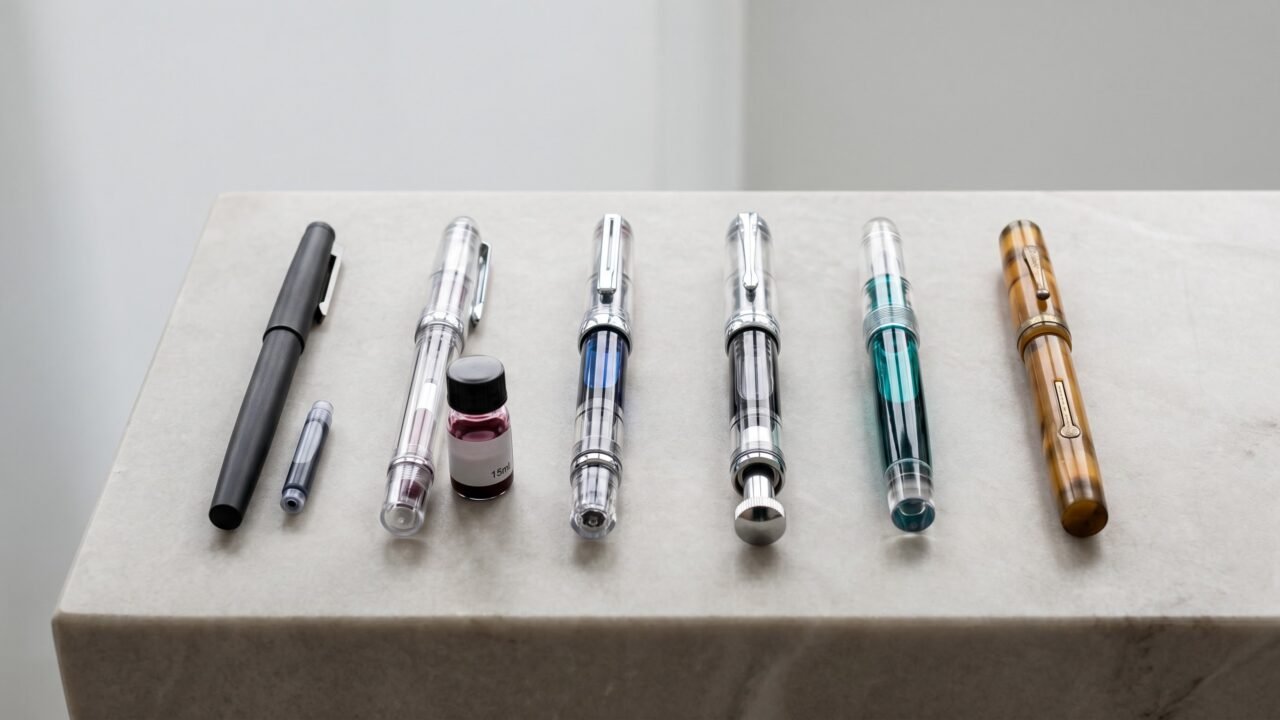
Every fountain pen needs a way to hold ink, and the mechanism it uses shapes everything: how you fill it, how long it lasts between refills, how many inks you can choose from, and how much fuss is involved. There are six main filling systems in use today and in vintage pens. Some hold barely half a milliliter; others hold more than four. Knowing how each one works makes it much easier to pick the right pen for your habits and to fill it correctly every time.
Before the rundown: flush any brand-new pen with plain water before its first fill. Manufacturing oils left in the feed and nib cause slow starts and skipping, and a quick rinse clears them.
Cartridge filling
A cartridge is a sealed plastic capsule pre-loaded with ink. You snap or push it into the pen’s grip section, the nib pierces the sealed end, and the pen is ready. No bottles, no mess. When the ink runs out, you pull the empty out and push a fresh one in.
Two formats dominate the market. The short international cartridge is 38 mm long and holds roughly 0.75 ml of ink; the long international runs 73 mm and holds approximately 1.5 ml. These standardized sizes fit dozens of European brands. Most Japanese manufacturers (Pilot, Sailor, Platinum) and some Western brands (Lamy, Kaweco) use their own proprietary dimensions, so you buy the brand’s own cartridges.
The tradeoff is ink choice. Cartridges are only available in the colors a manufacturer produces, which cuts you off from hundreds of bottled inks. Cost per milliliter is also higher than buying ink by the bottle. For occasional use or situations where carrying a bottle is impractical, cartridges are unbeatable. For anyone who wants to explore ink as a hobby in its own right, the other systems open the door wider.
Converter filling
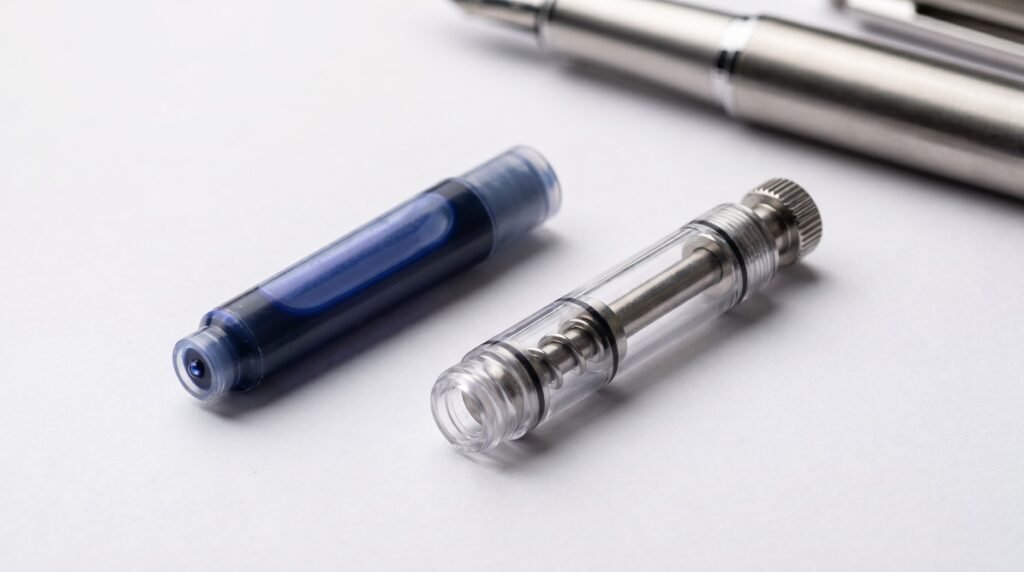
A converter slots into the same grip section as a cartridge but has a reservoir and a filling mechanism instead of pre-loaded ink. Dip the nib into a bottle, operate the mechanism, and ink draws in. Swap the ink whenever you like by flushing the converter and refilling.
Most converters use a piston: a small knob at the top drives a piston down the tube, expelling air, then you release to draw ink back up. Some use a squeeze mechanism instead, compressing the reservoir wall the same way you would a rubber bulb. Pilot’s CON-70 takes a different approach: a large push-button on the top drives a plunger piston in a single pump stroke, pulling a generous charge of ink straight in. It holds about 1.1 ml, making it one of the higher-capacity converter options available. Standard piston converters from brands like Lamy (the Z28 holds 0.8 ml) land toward the lower end of that range.
Converters generally hold slightly less than a comparable cartridge because the mechanism takes up internal space. The average is about 0.6 ml to 1.0 ml, with most landing around 0.8 ml. The real reward is access to every bottled ink on the market, including shimmer inks, iron gall formulas, and specialty shading inks. A 50 ml bottle gives you roughly 50 to 60 refills at a fraction of what the same volume in cartridges would cost.
For cleaning tips and when to flush your pen, see our guide to how to clean a fountain pen.
Piston filler
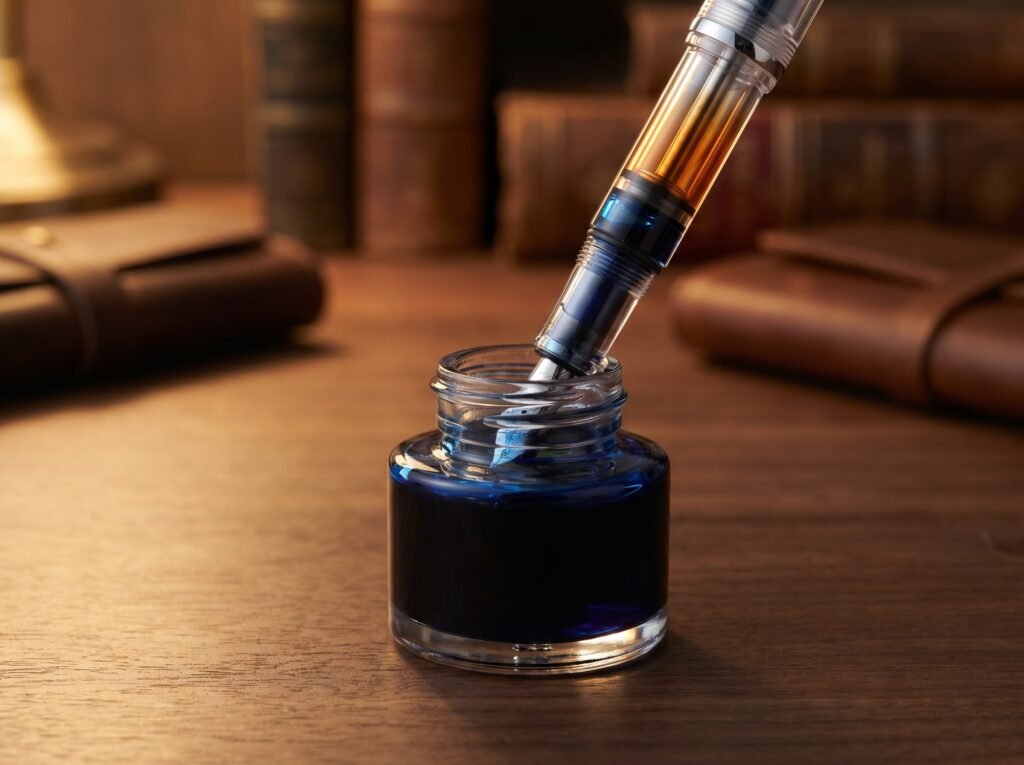
A piston filler is built directly into the barrel. The pen has no cartridge slot. Instead, a knob at the end of the barrel turns a threaded piston rod, driving the piston down the barrel to expel air, then drawing it back up to suck ink straight from the bottle into the reservoir. The entire barrel is the reservoir.
Pelikan popularized this design in 1929, and it has been the backbone of their Souveran lineup ever since. The M600, for example, holds 1.30 ml. TWSBI brought the piston filler to a much lower price point with the ECO, which holds approximately 1.76 ml thanks to its full-length demonstrator barrel. Sailor’s Realo line, the brand’s own piston-fill take on the 1911, manages about 1.0 ml. The Lamy 2000, a piston filler since 1966, holds approximately 1.35 ml by Lamy’s own specification, though the ink window makes the level easy to monitor.
Piston fillers are generally more ink-efficient than converters because there is no mechanism housing eating into the reservoir space. They require occasional maintenance: the piston seal needs a small amount of silicone grease once or twice a year to stay smooth. TWSBI ships their pens with a wrench and a jar of grease so you can do this yourself at home.
These pens also make excellent demonstrators. The clear barrel turns the ink color into part of the pen’s look, and watching the ink level drop over a writing session has a quiet satisfaction that cartridge pens never quite match.
Vacuum filler
A vacuum filler creates a rapid pressure drop to pull a large charge of ink into the barrel in a single stroke. The TWSBI VAC700R and Pilot Custom 823 are the most widely available examples in the current market.
On the VAC700R, the knob at the end unscrews to release a plunger. Pull the plunger back, submerge the nib, then push it down in one firm stroke. The compression drives a surge of ink through the nib and into the barrel. The VAC700R holds approximately 2.4 ml this way. An ink shut-off valve at the knob seals the reservoir when tightened, making the pen safer for air travel than most other filling systems.
The Pilot Custom 823 works on a similar principle with a locking mechanism that disengages the plunger for filling and re-engages it for writing. Enthusiasts widely report a capacity around 2.2 ml under normal filling.
Vacuum fillers ask a little more of you: the fill action takes practice to do without air bubbles, and you need the nib fairly deep in the ink to avoid drawing air. But for long writing sessions without a refill, very few systems compete.
Eyedropper filling
An eyedropper pen has no mechanism at all. The barrel itself is the ink tank. You unscrew the grip section from the barrel, use a syringe or pipette to fill the barrel with ink, apply a thin coat of pure silicone grease to the threads to prevent leaks, and reassemble. Capacity runs roughly 2 ml to 5 ml depending on the barrel size. The Platinum Preppy, a common conversion candidate, holds about 3 ml when converted this way.
Eyedropper filling is the oldest filling method. The earliest fountain pens, in the late 1800s, were all filled this way. Self-filling systems had largely displaced it by the 1920s, but it never disappeared, and there is a genuine revival underway driven by budget pens that happen to convert beautifully.
Not every pen converts safely. Acrylic, resin, and plastic barrels work well; pens with metal inner barrels or metal threads can corrode over time when submerged in ink and are better left as-is. The silicone grease must be 100% pure silicone, not a hardware-store silicone caulk or a petroleum-based product. A small O-ring over the threads, underneath the grease, adds another layer of protection against seepage. If your pen’s grip section has a rubber O-ring already built in, you may not need a separate one.
The main practical concern is “ink burp.” When the barrel warms in your hand, the air inside expands and pushes a bead of ink through the nib. Writing with the nib pointed slightly upward for the first few seconds after uncapping clears this reliably.
Sac and lever fillers (vintage)
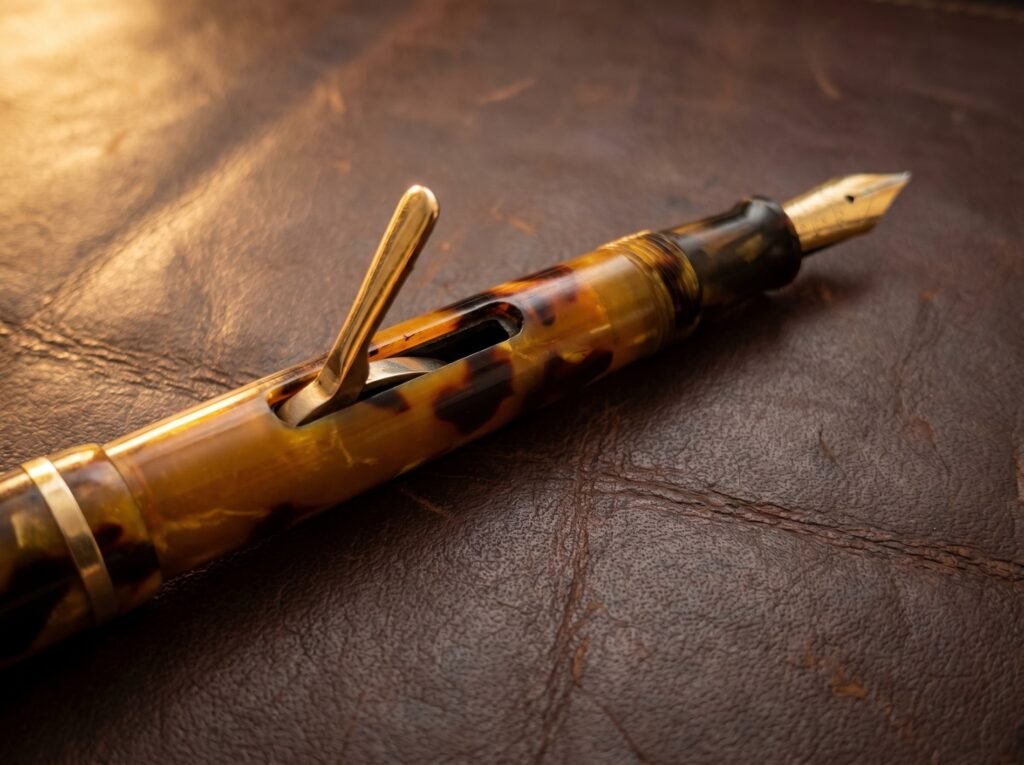
Before piston fillers took over, most fountain pens used a rubber sac inside the barrel as their ink reservoir. The lever filler, patented by Walter Sheaffer in 1908 and brought to market in 1912, became the dominant design for several decades. A metal lever on the side of the barrel presses a J-shaped spring bar inward, compressing the latex sac. Release the lever and the sac springs back, drawing ink in through the nib. Simple, reliable, and entirely mechanical.
Capacity varied by pen size but was typically modest: most sac pens from that era held 0.5 ml to 1.0 ml. The value today is access to the huge pool of vintage pens from Sheaffer, Parker, Wahl-Eversharp, Waterman, and others at reasonable prices.
Caring for a sac pen with modern inks takes some attention. High-pH alkaline inks are sometimes cited as a theoretical risk for latex, though testing by enthusiasts over extended periods has shown the real-world degradation rate to be modest with most modern dye-based inks. That said, the practical approach is to use gentler, well-known inks (Pelikan 4001, Waterman, standard Diamine) in vintage latex sacs, and to avoid shimmer inks, pigmented inks, and high-concentration iron gall formulas in any pen that has not had its sac recently replaced. A vintage pen with an old or unknown sac should go to a nibmeister or restorer before you fill it with anything.
Filling system quick-reference
The table below puts all six systems side by side so you can compare at a glance. Capacity figures are typical ranges; individual pens vary.
| System | Typical capacity | How you fill it | Ink access | Best for |
|---|---|---|---|---|
| Short cartridge | 0.75 ml | Snap capsule in, nib pierces seal | Brand cartridges only | Travel, beginners, quick swaps |
| Long cartridge | 1.50 ml | Snap capsule in, nib pierces seal | Brand cartridges only | Longer sessions, same convenience |
| Converter (piston) | 0.6-0.9 ml | Knob drives piston, dip-fill from bottle | All bottled inks | Desk writers wanting ink variety |
| Converter (push-button, e.g. Pilot CON-70) | ~1.1 ml | Push-button plunger, dip-fill from bottle | All bottled inks | Higher capacity converter option |
| Piston filler (built-in) | 1.0-1.8 ml | Knob drives internal piston, dip-fill | All bottled inks | Regular writers, demonstrators |
| Vacuum filler | 2.0-2.5 ml | Single-stroke plunger, dip-fill | All bottled inks | Long sessions, travel (with valve) |
| Eyedropper | 2.0-5.0 ml | Syringe fills barrel directly | All bottled inks | Maximum capacity, budget conversions |
| Sac / lever (vintage) | 0.5-1.0 ml | Lever compresses rubber sac, dip-fill | All bottled inks | Vintage collecting, classic feel |
Which filling system is right for you
For a first fountain pen, the cartridge or converter system is the easiest starting point. You get a wide range of pens at every price, you can start immediately with a cartridge, and adding a converter later costs only a few dollars and opens the entire world of bottled ink. The Lamy Safari and its Al-Star sibling are the most common entry points in this category, and the Z28 converter snaps straight in.
If you already know you want bottled ink and you write long stretches without stopping, a piston filler is worth stepping up to. The TWSBI ECO offers a full piston mechanism at a price well below most competitors, and its demonstrator barrel makes the ink level impossible to miss.
For maximum ink between refills at any price point, eyedropper conversion of a Platinum Preppy or similar plastic pen costs almost nothing and holds several times what a converter manages. It is also a satisfying way to understand the mechanics of fountain pen filling at a fundamental level.
Vacuum fillers and vintage sac pens are the step after that: higher investment, more rewarding once you know what you want.
For detailed notes on specific pens and how their filling systems affect real-world use, see our fountain pen reviews. We cover each system type in deeper detail: see best piston-fill fountain pens, best vacuum-fill fountain pens, best eyedropper fountain pens, best cartridge-converter fountain pens, and vintage sac pen guide.
Frequently asked questions
Can I use any bottled ink in a converter?
Almost any standard dye-based fountain pen ink works in a converter. Avoid India ink, calligraphy ink, acrylic ink, and dip-pen inks, which contain materials that clog the feed. Shimmer inks with large metallic particles can clog fine and extra-fine nibs, so they work best in medium or broader nibs.
How do I know when my pen needs refilling?
Piston and vacuum fillers with transparent barrels show the ink level directly. For cartridges and converters in opaque pens, the ink usually starts to run dry around the same time the line becomes visibly lighter or skipping increases. Tipping the pen nib-up briefly can confirm a low supply.
Is a piston filler harder to clean than a converter?
Slightly, because the reservoir is larger and fixed to the pen. Fill the barrel with water, flush, and repeat until the water runs clear. Most piston pens need three to five flush cycles to clear a saturated ink. Our how to clean a fountain pen guide walks through each system step by step.
Do vacuum fillers really not leak on planes?
The shut-off valve on the TWSBI VAC700R and similar designs does provide meaningful leak protection compared to open piston fillers, because it physically seals the ink from the feed. Enthusiasts widely report success traveling with the valve closed. No pen is completely immune to pressure changes, but vacuum fillers with a valve are among the better choices for air travel.
Read next
The Nibhaven team
We write plain-English fountain pen guides. Every claim is checked against the manufacturer documentation and primary sources listed above before publishing.