Best fountain pens: a practical guide to every budget, use, and nib type
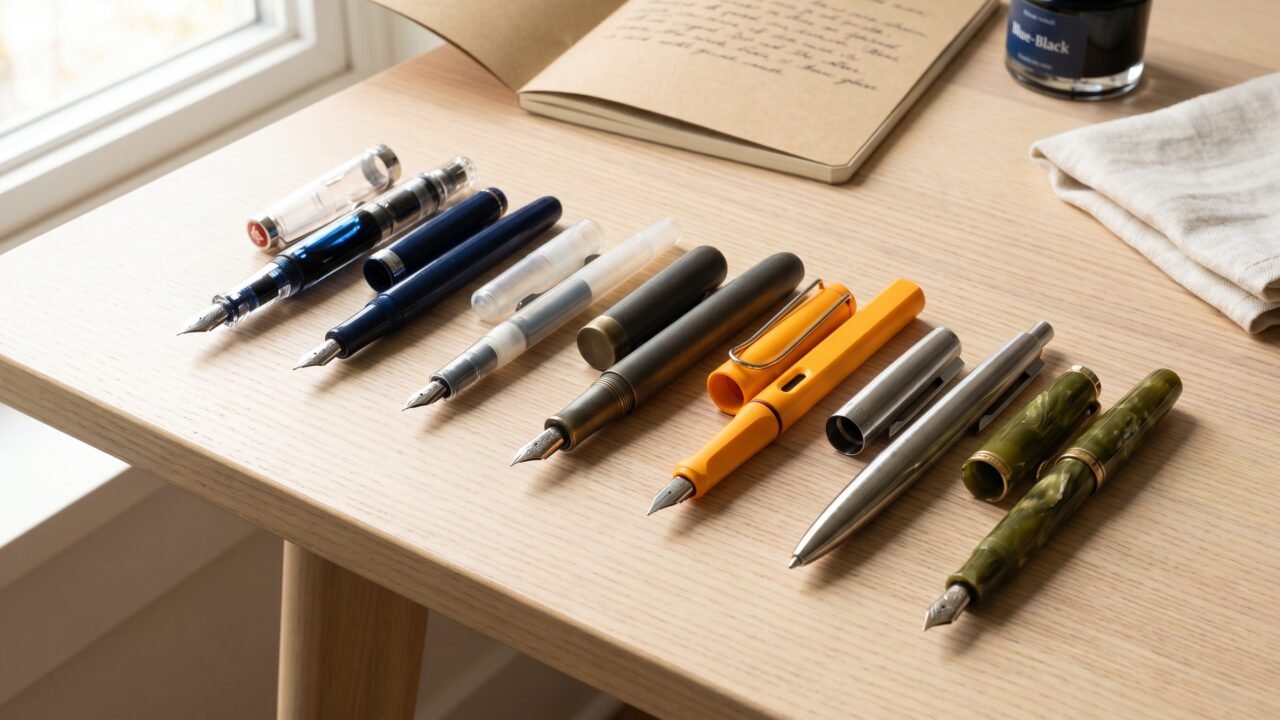
The best fountain pen for you depends on three things: how much you want to spend, what you plan to write, and how much you want to tinker. At $7, the Platinum Preppy writes beautifully out of the box. At $37, the Lamy Safari adds durability and a dozen color choices. At $300 and up, hand-tuned gold nibs from Sailor and Pelikan reward every writing session with something that genuinely feels alive under the hand. The jump between tiers is real, but so is the point of diminishing returns. Most people who fall in love with fountain pens do it somewhere in the $20 to $50 range.
This page is Nibhaven’s top-level buying hub. It gives you quick picks, a one-screen decision table, and the essential buying criteria. Every section links down to a deeper guide or review so you can go as far as you like. If you are brand-new to the hobby, start with our guide to fountain pens for beginners, which covers the entire getting-started journey from first purchase to first bottle of ink.
Quick picks: the Nibhaven shortlist by budget
These are the pens the Nibhaven team recommends most often, based on verified specifications, community reputation, and honest value at each price point. Prices are approximate MSRP in USD.
| Budget | Pen | Why it belongs here | Best for |
|---|---|---|---|
| Under $10 | Platinum Preppy | $7, slip-seal cap keeps ink fresh through extended non-use, smooth steel nib available in EF/F/M | First pen, spare desk pen, budget ink testing |
| Around $15 | Pilot Kakuno | $14, smiley-face nib shows correct orientation, triangular grip eases learning, hexagonal body stops rolling, 85% recycled plastic | Students, kids, anyone who forgets which side is up |
| Around $20 | Pilot Metropolitan (MR) | Brass barrel (substantial feel), stainless steel nib, includes squeeze converter, available in F/M/Stub | Daily note-taking, first pen with real heft |
| Around $35 | Lamy Safari | $37 official, impact-resistant ASA plastic, triangular grip, interchangeable steel nibs (EF/F/M/B/LH), vast color range, enormous spare-parts ecosystem | Heavy daily use, first pen to customize |
| Around $37 | TWSBI ECO | $36.99 official, piston filler (no cartridge cost), clear demonstrator barrel, postable, ships with wrench + silicone grease for DIY maintenance | High-volume writers, ink enthusiasts who want to see the ink level |
| Around $34 | Kaweco Sport | Classic Sport approx $34, pocketable capped (just over 4 in), posts to writing length, German-made nibs, compatible with standard international short cartridges | Pocket carry, desk pen that travels, compact writing style |
| $190+ | Pilot Vanishing Point | 18K gold nib, retractable click mechanism (no cap removal), built-in ink seal, cartridge/converter fill | Desk signers, left-handers who clip-post a ballpoint, one-handed users |
| $200+ | Pelikan M200 | Piston filler, gold-plated steel nib, classic German engineering, excellent build quality at the entry of the Pelikan Classic lineup | Step-up from mid-range, collectors starting the M-series journey |
| $300+ | Sailor Pro Gear / 1911 | 21K gold nib (standard on the full-size lines), hand-finished in Hiroshima, wet flow with Japanese precision; the Pro Gear has a more squared-off aesthetic, the 1911 is rounder | Writers who want a nib that rewards daily use over years |
Pick-by-need: one screen, every situation
Budget is only one axis. Here is the decision layer that narrows your choice by writing situation. This table is Nibhaven’s original artifact: no other page on the site simply maps need to pen in one place.
| Your situation | What matters most | Best picks | Avoid |
|---|---|---|---|
| You have never used a fountain pen | Forgiveness, low cost, easy filling | Platinum Preppy (F), Pilot Kakuno (F or M), Pilot Metropolitan (M) | EF nibs (scratchy until you learn pressure), piston-only pens (refilling takes practice) |
| Left-handed writer | Fast-drying ink, fine line, correct nib angle | Lamy Safari LH nib, Pilot Kakuno (EF), any pen paired with a fast-drying ink | Very wet-writing nibs, slow-drying shimmer inks, broad nibs |
| Small, tight handwriting | Fine line width | Any Japanese pen in F or M (equals Western EF/F); Platinum Preppy EF (0.2mm line) | Western B or BB nibs, stub nibs |
| Large, looping handwriting | Wet flow, broad line | Lamy Safari B, TWSBI ECO B, any German pen in M or B | Japanese EF or F (too fine, may look scratchy on large script) |
| Daily carry in a pocket | Compact, leak-resistant, durable | Kaweco Sport, Platinum Preppy (sealed cap) | Piston fillers at altitude (pressure changes), pens without inner cap seal |
| High-volume daily writer (journals, note-taking) | Large ink capacity, low per-fill cost, durable nib | TWSBI ECO (piston, see-through barrel), Pelikan M200 (piston) | Cartridge-only pens without converter option |
| Decorative writing, hand-lettering | Line variation, italic/stub nib | Lamy Safari stub 1.1, TWSBI ECO stub 1.1 | Round nibs (EF/F/M/B) for calligraphy effects (won’t give line variation); Platinum Preppy (round nibs only, no stub available) |
| Desk pen, no cap-removal wanted | Instant-start, one-handed operation | Pilot Vanishing Point | Pens with hard-starting nibs, pens that need posting |
| Gift for someone unsure about the hobby | Low risk, presentable packaging, works reliably | Pilot Metropolitan, Lamy Safari, Platinum Preppy with a small bottle of ink | Expensive gold-nib pens (wrong if preferences unknown) |
| Upgrade from a good starter pen | Improved nib feel, better filling, quality step-up | TWSBI ECO (piston step-up from cartridge pens), Pelikan M200 (German quality leap), Pilot Vanishing Point (unique retractable experience) | Buying a second $20 pen when you already have one that works fine |
How to choose a fountain pen: the four variables that actually matter
Most buying guides lead with brand prestige. That is the wrong place to start. Four practical variables determine whether a pen works for you.
1. Nib size and writing style
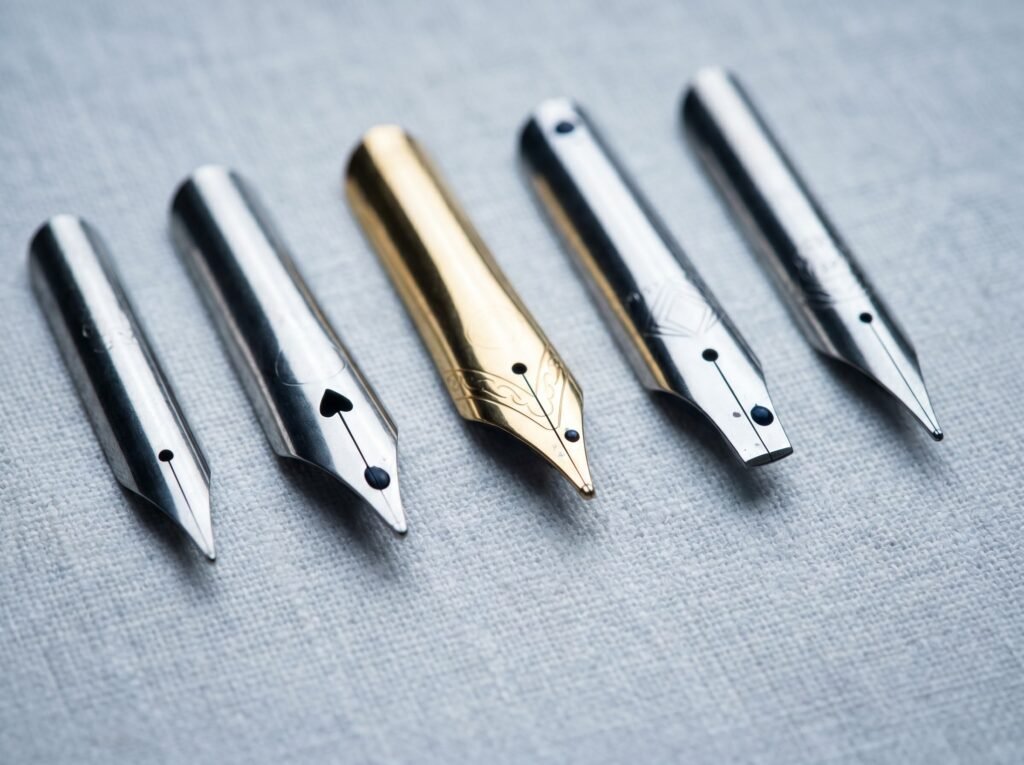
Nib size controls line width more than any other factor. Standard designations run from EF (extra fine) through F, M, B, and BB on most Western pens. Two things beginners get wrong here almost every time.
First: Japanese nibs run significantly finer than their Western size label suggests. A Pilot or Platinum M writes a line about as wide as a Western F. A Japanese F is close to a Western EF. Enthusiasts widely describe this as “one size finer,” and line-width measurements bear that out: a Japanese F produces lines around 0.45 mm, while a Western F sits closer to 0.6 mm. This is not a flaw. It reflects the precision needed for complex Japanese script. But it means you should size up when ordering a Japanese pen for the first time. More detail is in our guide to Japanese vs. Western nib sizes.
Second: bigger is not bolder in the way people expect. A medium nib on wet paper can produce a surprisingly broad line; a fine nib on absorbent paper can look almost as fine as an EF. The paper matters almost as much as the nib. That is covered in our best fountain pen paper guide.
2. Filling system
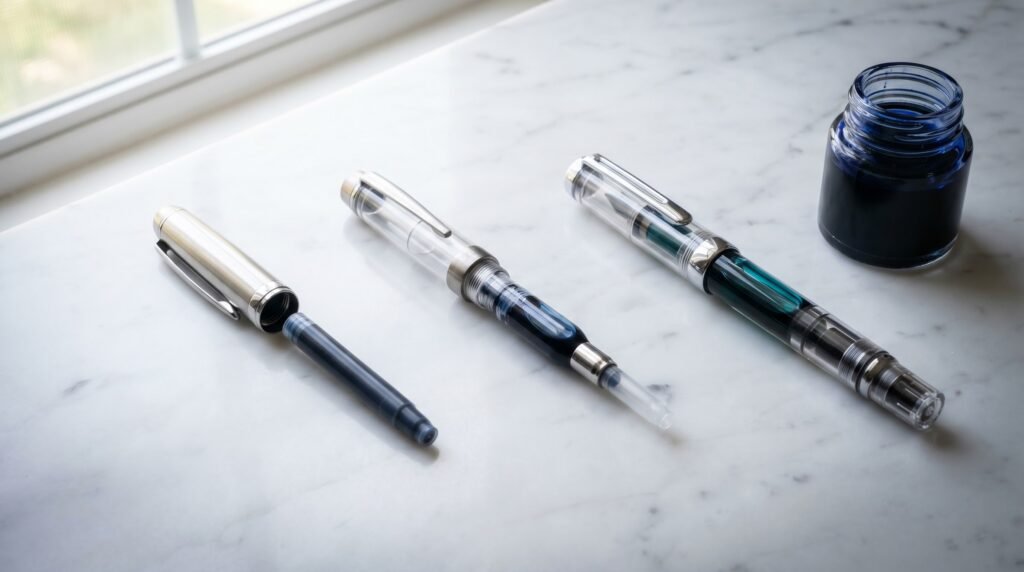
There are three common options. Cartridges are the easiest: snap one in, write. Most beginner pens accept standard international cartridges, but Pilot and Lamy use their own proprietary sizes – a Pilot cartridge will not fit a Lamy, and vice versa. Check before buying a second pen. Converters give you access to the full world of bottled ink. A converter replaces the cartridge in the same slot and fills by drawing ink directly from a bottle; the Pilot Metropolitan ships with one. Piston fillers like the TWSBI ECO and Pelikan M200 have a built-in mechanism and hold the most ink. They take slightly more practice to fill cleanly, but the cost per fill drops to almost nothing compared to cartridges, and the clear barrel on the ECO lets you see exactly how much ink is left.
Our guide to cartridges vs. converters covers the trade-offs in full.
3. Nib material: steel or gold
This is the variable people debate most, and the one that matters least below about $100. A well-made steel nib writes just as smoothly as a gold nib. The real difference is tactile: gold is softer than stainless steel, so a gold nib flexes very slightly under the pen’s own weight as you write, giving a cushioned, springy feel. Whether you notice this depends on your writing pressure and how tightly you grip. Writers with a light touch often do not feel the difference at all. Writers with a firmer grip often prefer the way gold absorbs the micro-vibrations of the nib against paper.
The Nibhaven team’s practical guidance: start on a steel-nib pen. If you find yourself wishing for something with more feedback and feel after six months, then gold is worth exploring. More on this is in our gold nib vs. steel nib comparison.
4. Body size and weight
Fountain pens range from pocket-size (the Kaweco Sport capped is just over four inches long) to full-size desk models (Pelikan M400 and above). Weight varies from 10 grams (Platinum Preppy) to nearly 30 grams for brass-bodied pens. Neither extreme is wrong. Heavier pens feel more substantial but tire some writers over long sessions. Lighter pens feel less impressive but cause less fatigue. If you write for more than 30 minutes at a stretch, lean lighter.
Grip diameter matters too. Section diameters mostly fall between 9 and 12 mm. Narrower is fine for smaller hands; wider suits large hands or writers who grip loosely. Ergonomic sections like the Lamy Safari’s triangular grip help if you have never consciously thought about how you hold a pen.
What every fountain pen buyer needs to know before they start
A few facts will save you from the most common frustrations.
Flush a brand-new pen before first use. Factory oils and residue from the manufacturing process can cause hard starts and inconsistent flow. A few rinses with room-temperature water clear it. This is standard care advice across all fountain pen manufacturers.
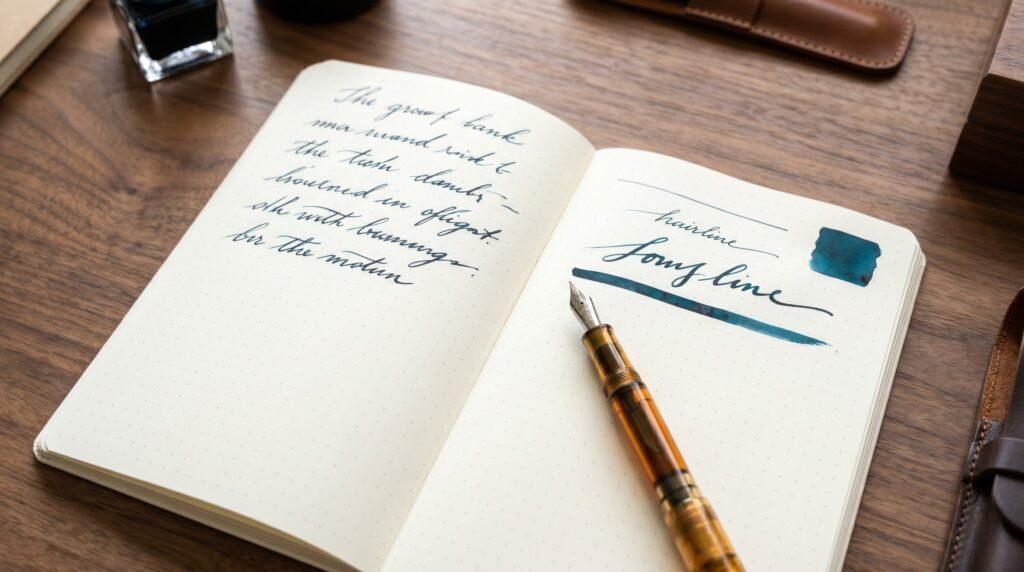
Write with almost no pressure. A fountain pen delivers ink by capillary action, not by pressing down. Pressing too hard spreads the tines and cuts off flow. It can also scratch or permanently misalign a nib. Light touch, let the weight of the pen do the work.
Use only fountain pen ink. India ink, calligraphy ink, dip-pen ink, drawing ink, and acrylic inks are not formulated for fountain pens. India ink contains a shellac binder that dries inside the feed and forms blockages that are nearly impossible to remove. Calligraphy inks use pigment particles that clog the narrow channels in the feed. Keep those inks for dip pens and brushes. Our guide on what happens if you use the wrong ink explains the damage in detail.
Shimmer inks need a wider nib. Shimmer inks contain suspended mica particles that give them glitter. In a fine or extra-fine nib, those particles settle and block flow. Enthusiasts widely recommend using shimmer inks only in medium or broader nibs, and flushing the pen within a week or two.
Some inks must not be mixed with others. Certain high-pH inks, notably Noodler’s Baystate Blue and related Baystate formulas, can react with other inks and damage pen parts if mixed. Use them alone, flush the pen thoroughly before switching to a different ink, and never blend them in a converter. This is a manufacturer-noted property of that ink line, not a defect.
Match wet nibs to dry inks and dry nibs to wet inks. Japanese nibs tend to run dry. German nibs tend to run wet. If your pen already runs dry, a dry ink (iron gall, most pigmented inks) can make skipping worse. A wet ink (Diamine, most Pilot Iroshizuku) helps. The reverse applies to a pen that floods. More on this in our wet nib and dry ink pairing guide.
Scratchy nibs are almost always fixable. Most scratchiness comes from misalignment or a slightly sharp tipping. Gentle micromesh on a flat surface can fix minor roughness. Anything beyond that belongs with a nibmeister. Trying to bend or grind a nib without the right tools and experience usually makes the problem worse.
The best fountain pens at every tier: deeper guides
The quick picks above get you started. These deeper guides go model by model within each budget range, with full spec comparisons and our honest verdict on each pen.
- Under $15: Best fountain pens under $15: the Platinum Preppy, Pilot Varsity, and a few surprises from Jinhao
- Under $30: Best fountain pens under $30: where the Pilot Kakuno and Metropolitan compete with Lamy and Kaweco
- Under $50: Best fountain pens under $50: the TWSBI ECO, Lamy Safari, Kaweco Sport, and first gold-nib contenders
- Beginners specifically: Best fountain pens for beginners: the curated shortlist with zero fuss, sorted by writing style
- Budget picks with personality: Cheap fountain pens that write well: honest coverage of sub-$15 options
For individual model deep-dives, our review hub at fountain pen reviews has the full library, from the Lamy Safari to the Sailor 1911.
Ink and paper: the two variables that change everything
No pen performs at its best with the wrong ink or paper. The Nibhaven team treats ink and paper as part of the pen purchase, not afterthoughts.
For ink, the fountain pen ink guide is the starting point. It covers ink types, safety, and how to pick your first bottle. For beginners, a simple dye-based ink in blue or black is the safest choice: easy to flush, widely available, works in all pens.
For paper, most copy paper bleeds and feathers with fountain pen ink. Even a single pack of Rhodia or Clairefontaine makes a visible difference. The full breakdown is in our best fountain pen paper guide.
Frequently asked questions
What is the best fountain pen for a beginner?
The Platinum Preppy at $7 is the lowest-risk starting point. The Pilot Kakuno at $14 adds an orientation-aid on the nib and a comfortable triangular grip. The Pilot Metropolitan at around $20 offers a brass body with real desk-pen weight. All three accept cartridges. The Metropolitan ships with a squeeze converter. The Preppy and Kakuno take converters sold separately, so you can move to bottled ink whenever you are ready.
Do you need expensive paper for a fountain pen?
Regular copy paper works, but most bleed or feather with wetter fountain pen inks. Paper treated with a sizing agent (Rhodia, Clairefontaine, Tomoe River) resists feathering and shows off shading and sheen. A single Rhodia pad under $10 shows the difference immediately. Full guidance is in the fountain pen paper guide.
Are Japanese fountain pen nibs really finer than Western ones?
Yes, consistently. A Japanese fine nib produces a line around 0.45 mm; a Western fine runs closer to 0.6 mm. Japanese M is roughly equivalent to Western F. The difference comes from the precision traditionally needed for Japanese script. When ordering a Japanese pen, size up one step from your usual preference. The full chart is in our Japanese vs. Western nib sizes guide.
Can you use any ink in a fountain pen?
Only inks labeled specifically for fountain pens. India ink, calligraphy ink, and dip-pen inks contain binders or pigment particles that clog the narrow feed channels. Some blockages from India ink’s shellac binder are permanent. Stick to dye-based or purpose-formulated pigment fountain pen inks from brands like Pilot, Diamine, Sailor, or Pelikan. Details are in our guide on the wrong ink in a fountain pen.
Is a gold nib worth the extra money?
For most daily writers, not at the start. Well-made steel nibs on the Lamy Safari, TWSBI ECO, and Pilot Metropolitan write smoothly and reliably. Gold nibs offer a subtle tactile give or springiness that rewards certain writing styles and grips, but the difference is modest compared to the price jump. After six months with a quality steel-nibbed pen, you will know whether you want that extra feel.
Read next
The Nibhaven team
We write plain-English fountain pen guides. Every claim is checked against the manufacturer documentation and primary sources listed above before publishing.